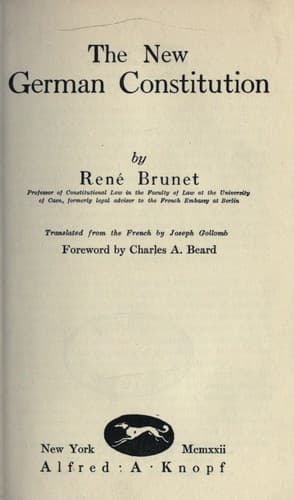
Germany -- Politics and government -- 1918-1933; Germany. Verfassung (1919)
In the course of this work two tendencies clashed: the necessity for
the development and strengthening of the unity of the Reich; and the
necessity, on the other hand, of assuring the states a sufficiently
individual existence. A compromise was effected; but more than ever
before perhaps the centralizing tendency was accentuated; and it has gone
as far as possible without completely suppressing the reason for the
existence of the states.
The authority of the Reich is more or less extended according to
circumstances. It can be, to use the technical expressions employed in
Germany, exclusive, concurrent, and normative.
1. The competence of the Reich is _exclusive_, when _it alone has the
right to legislate_, in the respect that the states cannot pass laws
on the matters touching this authority of the Reich, even if the Reich
abstains from using that right. These matters are enumerated in Article
6, which contains, as compared with the former constitution, important
innovations.
The relations with foreign nations are hereafter the exclusive province
of the Reich. The states lose the active and passive rights of legation,
and they cannot enter into relations with foreign states except through
the intermediacy of the Reich. However, Article 78 gives them the right
to conclude treaties with foreign powers on matters which belong to their
own proper legislative domains, policing of the frontier problems, for
example. But these treaties must secure in addition the consent of the
Reich.
Another novelty is the unification of the army. In place of the former
contingents there is hereafter an army of the Reich in the hands of
which is concentrated all the means of defence of Germany. The army is
hereafter from this point of view placed on the same basis as the navy.
In the same way there is an increase in the authority of the Reich over
the interior situation, the provisions according to which the Reich
only has the power to legislate on posts, telegraphs, and telephones.
It is true that the former constitution had put forward the principle
that the posts and telegraphs of the German Empire should be organized
and administered in a uniformed manner; but this provision and
principle was nullified by the fact that it was not applied in Bavaria
and in Wurtemberg, these states having in virtue of special treaties
“particular” rights. But these rights were annulled by the present
constitution.
Finally it must be noted that Articles 89 and 97 of the Constitution
granted the Reich the right to administer the railroads and the waterways
that served the general commerce. This right the Reich made use of in
appropriating in April, 1920, the railroads belonging to the various
states.
Public-domain text, read in full here on John Shaqi.
Reviews
Reviews
No reviews yet
Be the first to share your thoughts on this work.
Join the Discussion
Join the discussion
Sign in to leave a comment or review.
Sign InorCreate an account