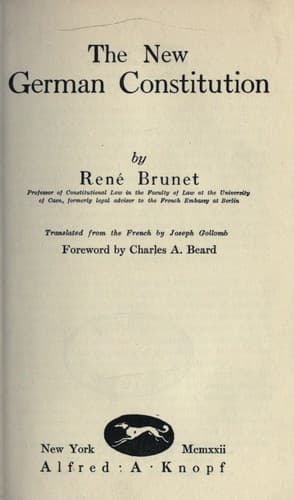
Germany -- Politics and government -- 1918-1933; Germany. Verfassung (1919)
The Constitution embodies several important provisions affecting this
question. Prussia has lost all the advantages it derived from the
fact that the German Emperor was the King of Prussia; the privileges
it enjoyed in the legislative initiative, in military matters and in
fiscal affairs have disappeared; the Bundesrat, in which it played a
preponderant rôle, and which was in itself the most powerful organ of
the Empire, is now reduced to a Reichsrat which can no longer prevent
anything. There is no longer a Chancellor nominated by an Emperor-King
and chief of all the _politique_ of the Empire and of the entire
administration; the powers of the Emperor have been transferred to the
President of the Reich elected by all the people; Prussia may even
against its will--though not for two years, it is true--be deprived of
several sections of its territory and see them erected into new states or
attached to still other states. All these diminutions of right have been
consented to by Prussia itself. Are they sufficient to suppress totally
the political domination which Prussia exercised over the German states,
small and great? It does not seem so, for there still remains this
paramount fact: _Prussia represents four-sevenths of the total population
of the Reich_; that is to say, Prussia alone has the majority. The Reich
being a democracy wherein the majority is sovereign Prussia is assured
in important questions of the opportunity to impose its will always on
Germany.
The remedy is evidently to divide Prussia into several states. But the
Constituent Assembly did not have the desire--or the force--to resort to
this; so that to-day Prussia is still above the Reich.
Perhaps another remedy is possible; and it is on this that those who wish
to place the Reich above Prussia base all their hope. That is to give to
Prussian provinces a very broad autonomy in such a way that their powers
being progressively increased, they will join little by little the states
whose powers are diminishing. There must be effected a decentralization
as complete as possible, in such a way that these provinces while still
remaining in the state of Prussia will have sufficient means to be able
to live individual lives and to impress their special temperaments on the
different acts of their political life. It would be necessary--and it is
there that the problem is most difficult--to maintain in these provinces
Prussian legislation and at the same time give them the right also to
legislate and assure them a sufficiently independent administration.
These are only projects and one cannot tell to what extent they are
realizable. We shall see, however, that the Constitution of Weimar has
timidly commenced an effort to realize them.
CHAPTER III
THE DEMOCRATIC PRINCIPLE
Public-domain text, read in full here on John Shaqi.
Reviews
Reviews
No reviews yet
Be the first to share your thoughts on this work.
Join the Discussion
Join the discussion
Sign in to leave a comment or review.
Sign InorCreate an account