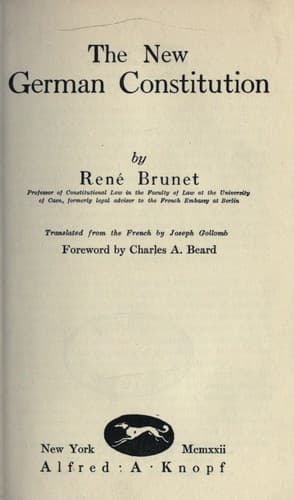
Germany -- Politics and government -- 1918-1933; Germany. Verfassung (1919)
If the National Assembly has not completely realized the unitary state
and has allowed traces of the federal régime to remain, it has fully
admitted the principle of national sovereignty and has applied it to a
greater extent than any other country in the world.
SECTION I
THE PRINCIPLE
The democratic principle was adopted by the majority of the National
Assembly without any difficulty. But in the public opinion there became
manifest certain tendencies which are either directly contrary to this
principle or whose consistency with this principle is debatable; and
some of them have received and are still gaining active and influential
adherence.
It is important therefore to define in reference to the principle of
national sovereignty the theories to which it finds itself subjected in
practice.
1.--THE POWER OF THE STATE IS DERIVED FROM THE PEOPLE.
Democracy is defined as government by the people; a democratic government
is a government in which sovereignty resides in the people, or, to
speak more precisely, one in which the will of the majority determines
sovereignty.
That this principle was completely ignored in practice in Germany before
the Revolution we already know. According to the Constitution of 1871
sovereignty belonged to the ensemble of confederated princes, Germany
being governed by an association of monarchs under the all-powerful
direction of one of them, the King of Prussia.
Such a system obviously could not survive the disappearance of the
monarchs themselves; and after the Revolution the democratic principle,
to which Bismarck had given the semblance of expression in creating
a Reichstag elected by universal suffrage, became fully applied. One
consideration contributed above all to the establishment of government
by the greatest number: The German Princes had governed and had
conducted themselves as monarchs by divine right; under their régime
no social class could develop to which a certain political power could
be given over, which the people would become accustomed to regard as
authoritative. There was in Germany no political nobility, no bourgeoisie
invested with political power. So that when sovereignty fell from the
weakened hands of the monarchs it could be taken over only by the people.
The people are therefore sovereign. German jurists go on to say that the
people cease to be the object of sovereignty and become the subject of
sovereignty.
But we are here in a federal state, and the problem becomes more
complicated because of the particular form of the state. For there are
here, in theory at least, two sovereignties: that of the Reich, and that
of the State. Which is the primary sovereignty?
Public-domain text, read in full here on John Shaqi.
Reviews
Reviews
No reviews yet
Be the first to share your thoughts on this work.
Join the Discussion
Join the discussion
Sign in to leave a comment or review.
Sign InorCreate an account