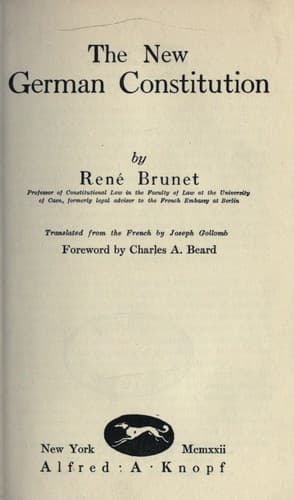
Germany -- Politics and government -- 1918-1933; Germany. Verfassung (1919)
In the Reich sovereign power belonged to an assembly of Princes and of
governments represented by the Bundesrat or Federal Council. This council
which consisted of representatives of all the member states shared with
the Reichstag the power to initiate and vote legislation. It promulgated
the general administrative measures necessary for the execution of the
laws; and with the consent of the Emperor it could dissolve the Reichstag.
The nation was presided over by the German Emperor. He exercised
generally the rights which modern nations reserve to the executive power.
In particular he represented the Empire in its international relations;
promulgated its laws; watched over their execution; appointed civil and
military officials, etc.
Several remarkable details have to be pointed out. Although in principle
the Emperor’s actions had to be countersigned by a minister he was free
from that restriction in such matters as concerned military affairs,
particularly in the nomination of the superior officers of the army and
the navy. The German Emperor was the absolute chief of the forces of the
Empire on sea and land. Furthermore, although he could not declare war
without the consent of the Bundesrat he could act on his own authority in
case of attack by a foreign power against the territory or the coasts of
the German Confederation.
The Emperor nominated the Chancellor, who was after the Emperor himself,
the sole chief of the political and administrative organization of the
Empire. “The Chancellor,” says Article 15, “presides over the Bundesrat
and directs its labours.” But as he clearly could not himself assume such
an overwhelming task, he was authorized by the law of March 17, 1878,
to call assistance and be supplemented at need by high functionaries
placed at the head of Imperial departments--those of foreign affairs, of
the interior, justice, treasury, railroads, marine, colonies, posts and
telegraphs. These officials carried the title of State Secretaries, which
seemed to give them something of the nature of ministers, though in
reality they were completely subordinated to the Chancellor.
Just as the Bundesrat represented the federated Princes so the Reichstag
represented the German people. Elected by direct and universal suffrage
the Reichstag had the right to initiate legislation; and no law was
operative unless it had obtained a majority both in the Bundesrat and in
the Reichstag. Furthermore the Reichstag had the right to interpellate,
not the Secretaries of State but the Chancellor himself and to ask
questions; and discussions of a question could be closed by voting an
expression of the confidence of the Assembly.
Under the Empire there were twenty-five states[1] and the territory of
Alsace-Lorraine.
Public-domain text, read in full here on John Shaqi.
Reviews
Reviews
No reviews yet
Be the first to share your thoughts on this work.
Join the Discussion
Join the discussion
Sign in to leave a comment or review.
Sign InorCreate an account