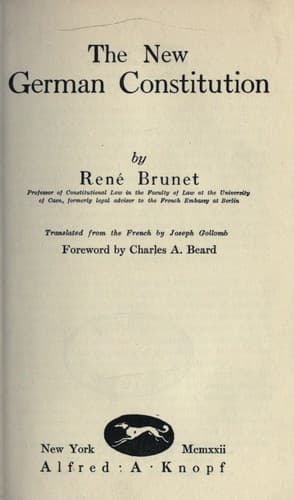
Germany -- Politics and government -- 1918-1933; Germany. Verfassung (1919)
Causes for the deprivation of the electoral right of individuals are
reduced to a minimum. The only ones denied this right are those who are
placed under guardianship and those who have been deprived of their
civic rights by a court decision. Bankrupts and paupers preserved their
electoral rights, in contrast to their situation before the war. Soldiers
who had taken part in the elections for the National Assembly were again
disenfranchised so long as they remained under colours. Finally certain
other conditions, which did not involve the loss of electoral rights,
still prevented their exercise: detention in institutions for mental
ailments and imprisonment, including preventive imprisonment. The laws
specified, however, that individuals imprisoned for political reasons
could demand that measures be taken to permit them to exercise the right
to vote.
To be able to vote, when one is an elector, one has to be entered on
an electoral list or on an electoral roll, or be furnished with an
“electoral certificate.” These last two institutions are unknown in
France and must be explained.
Germany ignores the principle known as permanence of electoral lists.
Before the Revolution electoral lists were in principle revised for each
election to the Reichstag. But the granting to women of the right to
vote, which doubled the number of electors, and the fact that thereafter
the electors of the Reich would have to vote not only every four years
for the Reichstag, but also in the election of the President, and
in cases of referendum, initiative, and plebiscites provided by the
Constitution, have increased the difficulty of retaining the former
system pure and simple.
There were in addition different proposals made to abolish it completely
and to replace it by a procedure which would do away entirely with
electoral lists. There would be given to each elector an “electoral
passport” or a “citizenship card”[28] which would be sufficient to
enable him to vote. But these propositions were rejected because of
the considerable cost of the passports or of the cards, and because of
the technical difficulties of furnishing adequate photographs of all
the electors, necessitated by this scheme; and in addition because for
certain votes, such as plebiscites and initiatives, it is necessary that
the number of individuals having the right to vote be known, which would
be difficult according to the systems proposed.
Public-domain text, read in full here on John Shaqi.
Reviews
Reviews
No reviews yet
Be the first to share your thoughts on this work.
Elsewhere in the archive
Join the Discussion
Join the discussion
Sign in to leave a comment or review.
Sign InorCreate an account