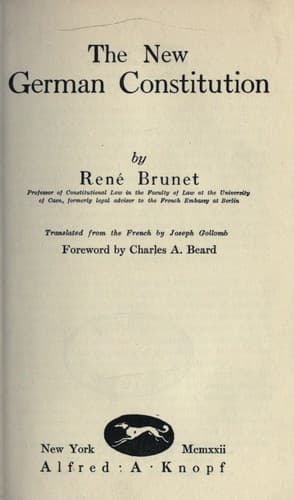
Germany -- Politics and government -- 1918-1933; Germany. Verfassung (1919)
It must be noted that those who, without being permanently deprived of
the right to vote, are only prevented from voting by certain special
circumstances, because of being under colours, or imprisonment, or
because by mistake they have been left off electoral lists, are eligible
for election. In the same way civil servants are also eligible. German
law does not know relative ineligibilities, which French public law
admits.
III.--PREPARATION OF ELECTIONS.
In a country of sixty million inhabitants of whom more than half
are electors and vote, above all, where the system of proportional
representation has been adopted, preparation of the elections takes
on special importance. An organization must be provided which permits
to each elector the exercise of his right, and, as far as possible,
facilitates it.
German law provides to this end a rather complex machinery. First, it
provides for a table of thirty-five electoral districts into which the
territory of the Reich is divided, and for seventeen groups of districts,
into which districts are joined.
Then it institutes a whole series of organisms appointed by the
administration and charged with the duty of seeing that the electoral
procedure was carried out properly. These organisms are:
1. Electoral committees, which have as their function the examination
of lists of candidates, the union of such tickets, and the compiling of
the election results for each degree of the distribution of seats in the
Reichstag. There are electoral committees for each district, for each
group of districts, and a committee for the Reich. 2. Superintendents
of elections, who preside over electoral committees, whose function for
each stage of division of seats is to confer with the representatives of
political parties, to receive lists of candidates and the declarations
in which the parties “join” their tickets or make up a ticket for the
Reich; these superintendents announce the decisions. 3. Chairmen of
election boards who supervise the electoral operations in their boards.
4. Election boards which consist, in addition to the chairman, of
three members and six assistants, who supervise the voting and pass on
the validity of ballots. 5. Men trusted by political parties who serve
as intermediaries between them and the administrative authorities. 6.
Distributors of electoral envelopes, etc.
The law specifies very clearly the manner in which lists of candidates
must be drawn up and presented. There are or may be for each party
district tickets and a ticket for the Reich; there are no tickets for
groups of districts. These tickets must include only eligible candidates,
the status of eligibility of a candidate being examined by the competent
electoral committee. The lists must be signed by 50 or 20 electors,
according to whether the ticket is for a district or for the Reich. A
candidate may appear on the tickets of different districts but not more
than once within the same district.
Public-domain text, read in full here on John Shaqi.
Reviews
Reviews
No reviews yet
Be the first to share your thoughts on this work.
Elsewhere in the archive
Join the Discussion
Join the discussion
Sign in to leave a comment or review.
Sign InorCreate an account