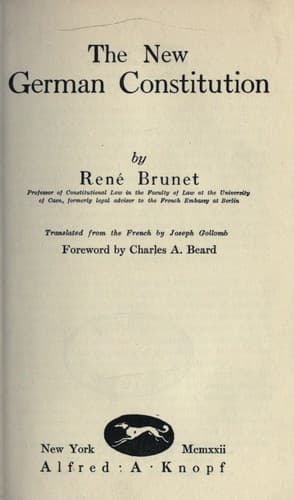
Germany -- Politics and government -- 1918-1933; Germany. Verfassung (1919)
The people express themselves not only on the text of a law. They are
also the great political judges, the supreme arbiters to whom must be
submitted all difficulties of vital importance to the nation. The people
give to the organs chosen by them the right to legislate and to govern;
but if a discord arises between these organs or if these organs once
nominated do not bend to the people’s will, they intervene themselves on
the appeal of one of the organs or of their own accord. Direct government
expresses itself, therefore, when a conflict arises either between the
organs of national representation, or between this representation and
the nation itself. In these two cases it is the people who decide the
conflict.
* * * * *
First, then, discord may arise between the organs of national
representation. Being given a multiplicity of these organs the issues in
which the people is thus appealed to for intervention may be of several
kinds.
(1) The conflict may arise between two legislative chambers of the Reich.
If the Reichstag and the Reichsrat cannot agree on the text of a law, the
President of the Reich may or must, according to circumstances, order the
text to be submitted to a popular referendum. The conditions under which
this referendum is to take place are different according to whether the
law in question is a constitutional one or an ordinary law.
If the law in question is to be an amendment of the Constitution, the
presupposition is, that (Article 76) this change has been passed by the
Reichstag and objected to by the Reichsrat. If the Reichstag does not
yield to this objection and persists in its first decision, or if it
modifies it but in a manner not entirely conforming to the exigencies of
the Reichsrat, the latter may demand a referendum and the President must
order it.
If, on the other hand, it is an ordinary law that is in question, the
presupposition is again that the Reichsrat has objected to a law voted
by the Reichstag and that the latter disregards this objection. The
President in such a case is allowed to decide whether the situation
remains as it is--that is to say, that the projected law fails of
enactment; or, that the difficulty between the two Assemblies shall be
submitted to a referendum. It must be noted besides that these matters
referred for referendum to the people must be limited to the divergencies
arising between the two assemblies, and that the people pronounce for
either the text of one assembly or that of the other. If, however, the
Reichstag has rallied a majority of two-thirds against the objection
raised by the Reichsrat the choice on the part of the President is
thereby limited. He can only either promulgate or publish the law, or
refer it to the people.
(2) The conflict may arise between Parliament and the President; and this
may present two quite different aspects.
Public-domain text, read in full here on John Shaqi.
Reviews
Reviews
No reviews yet
Be the first to share your thoughts on this work.
Elsewhere in the archive
Join the Discussion
Join the discussion
Sign in to leave a comment or review.
Sign InorCreate an account