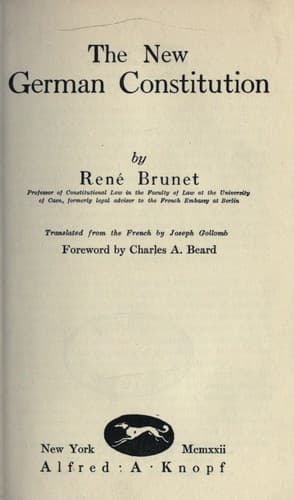
Germany -- Politics and government -- 1918-1933; Germany. Verfassung (1919)
The two chambers are in accord on the text of a law which the President
does not approve; this is the first kind of conflict. In such a case,
unless the President wants to promulgate the law adopted, he must submit
the text to a referendum (Article 73, par. 2). It is in effect a very
strong right of veto given to the President and accorded to him without
much difficulty. The Independents, however, in accordance with their
thesis of the uselessness of the President, did not want to grant this
right to appeal to the people in such a case, except to a responsible
minister. Also the members of the German People’s Party opposed the
granting of this power as useless, being a duplication of the President’s
right to dissolve Parliament. The majority of the Assembly, however,
disagreed with them.
The German Nationals saw in this measure new opportunity to strengthen
the authority of the President and did not let the occasion escape them.
The parties of the coalition, on the other hand, felt that in investing
the President with these powers they only applied logically their
democratic principles. The referendum appeared to them, in addition in
this particular case, less of an increase of the President’s powers than
as a corrective of the fact that he has powers too great. A democracy,
according to them, can with less risk give itself a strong executive, if
it also includes among them his right to call a referendum in case of
conflict, which would thereby enable the people to rule on the conflict.
On the other hand, the supporters of the principle of separation of
powers supported this use of the referendum, which seemed to them more in
conformity with their principles than the power to dissolve the Reichstag.
Another kind of conflict which can arise between the Reichstag and the
President is not merely a question of legislation but of general policy.
According to the terms of Article 43, par. 2, “the President may be
removed by the vote of the people on proposal of the National Assembly.”
This provision was adopted without discussion and its presence in the
German Constitution is quite understandable. The National Assembly wished
to create a strong president; in fact, it has given him almost absolute
power. He is the man entrusted by the people along with the Reichstag
and the Cabinet. If he betrays this trust who other than the people
themselves should decide that? But if he has retained the confidence of
the people, what is there to fear from his being brought before it as
a tribunal? In addition to this Article 43 specifies wisely that the
vote, whereby the Reichstag decides to place the question of removal
of the President before the public, must be a majority of two-thirds.
Finally the same Article logically provides that if the people pronounce
against the removal of the President in such an instance, the Reichstag
is thereby dissolved, for it is the latter in such a situation that has
ceased to be in contact with the people.
Public-domain text, read in full here on John Shaqi.
Reviews
Reviews
No reviews yet
Be the first to share your thoughts on this work.
Elsewhere in the archive
Join the Discussion
Join the discussion
Sign in to leave a comment or review.
Sign InorCreate an account