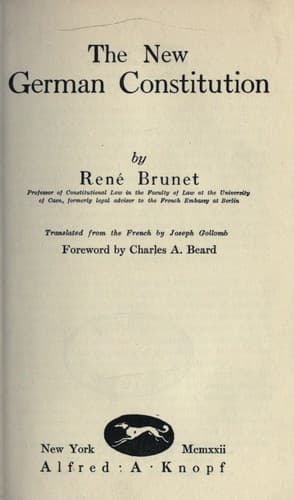
Germany -- Politics and government -- 1918-1933; Germany. Verfassung (1919)
(3) A conflict can also arise within the Reichstag itself. The hypothesis
is provided by Article 73, par. 2, thus: “A law whose promulgation is
deferred at the demand of at least one-third of the National Assembly
shall be submitted to the people, if one-twentieth of the qualified
voters so petition.”
This procedure complicates the work of the legislator. Dr. Heinze, member
of the German People’s party, has developed the following argument with
much force: A project of law has been sent by the Cabinet, with the
approval of the National Council, to the Reichstag, which, however, votes
a different text for it. This text comes back to the Reichsrat, which
raises objection to it. The Reichstag on a reconsideration of the text
adopts a compromise, as in the great majority of actual instances. But
there is always in the Reichstag a minority opposed to this compromise,
one which proposes to postpone the promulgation of the law and to submit
it to a referendum. For this proposal to become operative, it is required
that one-twentieth of the electors of the Reich support it, which, if
obtained, compels a popular referendum on this matter. This procedure is
extremely complicated and can often become dangerous. For one-third of
the Reichstag, forced by the party or the group that is behind it, can
feel itself obliged to propose a referendum to the people even when the
Reichstag and the Reichsrat have concluded happily a precise agreement.
Into this agreement there becomes injected a referendum with all its
hazards.[31]
In spite of this criticism the text was adopted because in Germany
cabinets are most often formed by temporary coalition of parties; and
the provision in question has the effect of giving an existing coalition
longer life and permitting the solution of disputes, thereby avoiding the
break-up of the coalition or a dissolution of the Reichstag.
(4) A conflict, finally, may arise between the government of the Reich
and that of a state over the question which is perhaps the most serious
one that can arise in a federal state--the territorial constitution of
member states. Suppose the question comes up of either changing the
territorial boundaries of a state or forming a new state. If one of the
states in question refuses to give its consent the population is then
consulted and it decides.
* * * * *
There is another kind of conflict, more serious perhaps than those just
examined. These are the conflicts that arise between the people and its
representatives. Let us suppose that the latter do not carry out the
provisions or the orders given them by the people. The latter in such a
case take matters into their own hands, with or without the collaboration
of the representatives, and impose their will upon them. Such a procedure
is popular initiative.
But here, too, several hypotheses must be distinguished:
Public-domain text, read in full here on John Shaqi.
Reviews
Reviews
No reviews yet
Be the first to share your thoughts on this work.
Elsewhere in the archive
Join the Discussion
Join the discussion
Sign in to leave a comment or review.
Sign InorCreate an account