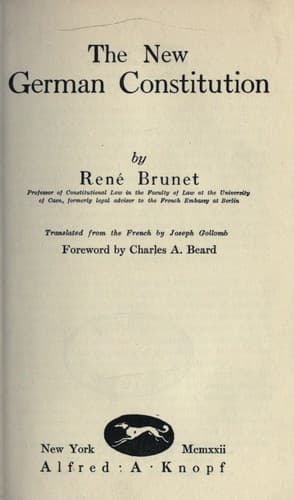
Germany -- Politics and government -- 1918-1933; Germany. Verfassung (1919)
(1) The people, for example, want a law which its representatives do not
give it. Shall the people be given the right themselves to bring that law
into being?
The parties of the Right of the Assembly supported the negative to this
question with considerable force. They held that to give the people such
a right to initiate legislation is to set up a rule of mistrust against
the qualified organs of national representation. Once these organs are
elected, they bear the responsibility of their decisions in the eyes of
the nation, and the latter must give them freedom to act. But to submit
representatives to the incessant control on the part of the people is
an exaggerated democratization. Further, if the Reichstag does not pass
the law demanded by the people, the President, the man in whom trust
has been placed by the nation, has only to dissolve the Reichstag.
Modern laws, also, are too complicated for the people to be able to give
qualified decision on everything they feel like deciding.
The supporters of such initiative replied that a control of this kind
over Parliament could not be instituted by leaving it all to the
President of the Reich alone. Occasions may arise in which both the
President and the Reichstag have lost contact with public opinion;
in which case it would be necessary for the people to make its voice
heard. It is also a truth born of experience that all great political
and social thoughts are at first the product of very small groups, and
it is only little by little that these become impressed on the masses.
The initiative is only a particular form of this evolution, and it
presents also this advantage, that it gives the popular movement the
chance to concentrate on a particular and important question, instead
of, as in ordinary elections, becoming dissipated among a large number
of questions of unequal interest. Finally, the example of Switzerland is
very encouraging. The proof is found there that the people often see more
clearly than their government, and that the initiative is the most solid
bulwark against the impositions of extremists. In the last analysis the
possibility of a popular initiative makes the political activity of the
government more living, and influences public agencies democratically in
a very desirable sense.
Public-domain text, read in full here on John Shaqi.
Reviews
Reviews
No reviews yet
Be the first to share your thoughts on this work.
Elsewhere in the archive
Join the Discussion
Join the discussion
Sign in to leave a comment or review.
Sign InorCreate an account