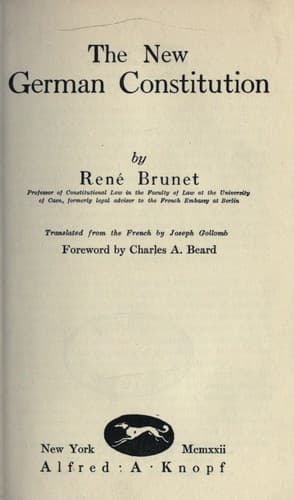
Germany -- Politics and government -- 1918-1933; Germany. Verfassung (1919)
Finally legislative initiative by the people has been included in the
Constitution (Article 73, par. 3), but under certain conditions. It is
required that a detailed bill be submitted, to avoid the possibility that
the people may be called to decide merely on a general principle, about
which it is very easy to create an artificial disturbance. It provides
that one-tenth of the electors of the nation must support this bill.
This approval given, the Cabinet is obliged to submit the text to the
Reichstag after stating its own attitude on it. The Assembly then either
accepts the bill, thus satisfying the people; or it changes or rejects
it; in which case a referendum is then resorted to, in which the people
decides as the final resource.
(2) A second hypothesis is that in which a conflict between its people
and its representatives, or a part of its representatives, occurs as
in the case we have already described, where a third of the members of
the Reichstag demand that the promulgation of a law be deferred. It is
recalled that in such a case a referendum is obligatory if one-twentieth
of the electors of the nation support the demand of these deputies. There
is in this a combination of the initiative and the referendum. The action
of the deputies of the minority of the Reichstag in order to achieve a
referendum must be supported by an already considerable number of the
country’s electors.
But it must be noted--and this applies equally to the two kinds of
initiative we refer to--that according to the terms of Article 73, par.
4, certain laws are not open to popular initiative, and consequently to
referendum. These are the laws which because of their financial character
offer to electors a very strong temptation to profit by their sovereignty
to make their personal interest prevail. Such laws are those on the
budgets and taxes and those relating to the salaries of civil servants.
(3) There is finally a last instance in which popular initiative may
operate. It is that provided by Article 18, par. 4, whereby a population
wishes the government of its state and the government of the Reich to
proceed to a change in the territory of the state or to the creation of
a new one. If one-third of the inhabitants demand it the Cabinet of the
Reich is obliged to order a referendum.
* * * * *
Such are the conditions and the limits within which the Constitution
provides for direct government within the Reich. It prescribes that a
law shall be enacted regulating the details of the application of the
principles it puts forward; but up to the present time this law has not
yet been enacted. The Cabinet has, however, proposed a bill concerning
it.[32]
In the case of discord between the organs of the state, that is to
say, in the case where the people are called in by one of the organs
in conflict, the government proposes to apply, _mutatis mutandis_, the
procedure prescribed by the electoral law.
Public-domain text, read in full here on John Shaqi.
Reviews
Reviews
No reviews yet
Be the first to share your thoughts on this work.
Elsewhere in the archive
Join the Discussion
Join the discussion
Sign in to leave a comment or review.
Sign InorCreate an account