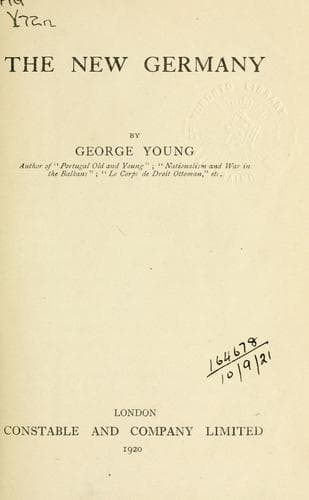
Germany -- History -- Revolution, 1918; Germany -- Politics and government -- 1918-1933
The whole policy of partitioning Prussia very soon broke down before a
Prussian, national unity that was the growth of centuries. This
national sentiment expressed itself in violent opposition not only
from the Prussian ruling class, to whom Prussian unity was a necessary
condition for a monarchical and militarist reaction, but also to the
Prussian proletariat, who considered it a necessary condition for the
success of the Revolution. Nor, oddly enough, was it favoured even by
the Southern and Catholic interest who in the past had been most
jealous of Prussia. For they argued that if Prussia were reduced to
provincial departments, their own State rights would not remain
unrestricted. And State right had become all the more precious to the
clerical parties since revolution had threatened them both from above
and below, from a Socialist Central Government above and from
Communist Council Governments below. Partition had therefore to be
abandoned and the difficulty of Prussian preponderance was solved by
an arbitrary reduction of Prussian representation, as in the
Constitution of 1871. In the old Bundesrat Prussia was represented by
17 votes out of 61 (counting Alsace-Lorraine). Art. 61 of the present
Constitution restricts Prussia to two-fifths of the total votes,
having raised the proportion from one-third in the previous drafts.
That is, Prussia used to have rather more than a quarter, and now has
rather more than a third of the votes in the Federal body.
This might look like a reaction into Prussianism; but only until the
functions of this Federal Body are examined. Sovereignty, under the
old Constitution, resided in the dynasties, and the old Bundesrat was
a council of diplomatic delegates, comparable to the Supreme Council
at Paris. These delegates, as representatives of the Crown,
intervened, not only in legislative but even in administrative
matters, such as appointments. Moreover, in this Council, the Prussian
representatives had a privileged position, as they received their
instructions from the Prussian Government in which the Imperial
Chancellor was Premier. In the first drafts of the Constitution we
find the sovereignty divided between representatives of the State and
representatives of the people. Thus the Staatenhaus and Volkshaus
combine to make the sovereign Reichstag. But in the present
Constitution, all sovereignty expressly resides in the popular
Chamber, the Reichstag. The Reichsrat becomes no more than a sort of
Imperial Conference with defined and carefully delimited
constitutional powers; and, in the Reichsrat, Prussia has no
privileged position whatever.
Public-domain text, read in full here on John Shaqi.
Reviews
Reviews
No reviews yet
Be the first to share your thoughts on this work.
Elsewhere in the archive
Join the Discussion
Join the discussion
Sign in to leave a comment or review.
Sign InorCreate an account