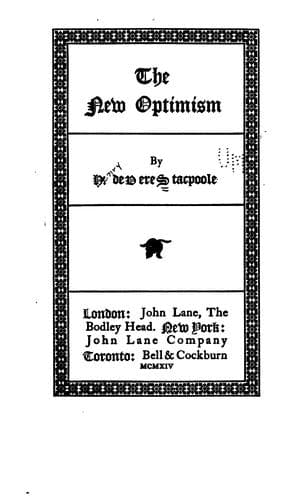
The New OptimismStacpoole, H. De Vere (Henry De Vere)
Philosophy
The New Optimism
Stacpoole, H. De Vere (Henry De Vere)
Evolution; Faith; Social problems; Stacpoole, H. De Vere (Henry De Vere), 1863-1951 -- Philosophy
The world is not all wrong, but it is not all right. Man is speaking
in no uncertain tones, and he wants some reply more apposite to his
argument than the glib chirrup of Pippa.
APPENDIX B
A PASSAGE FROM HAECKEL*
Under the title of _Design in the Living Organism_, the famous
embryologist, Carl Ernst Baer, published a work in 1876 which, together
with the article on Darwinism which accompanied it, proved very
acceptable to our opponents, and is still much quoted in opposition to
evolution. It was a revival of the old teleological system under a new
name, and we must devote a line of criticism to it. We must premise
that, though Baer was a scientist of the highest order, his original
monistic views were gradually marred by a tinge of mysticism with the
advance of age, and he eventually became a thorough dualist. In his
profound work on _The Evolution of Animals_ (1828), which he himself
entitled _Observation and Experiment_, these two methods of
investigation are equally applied. By careful observation of the
various phenomena of the development of the animal ovum, Baer succeeded
in giving the first consistent presentation of the remarkable changes
which take place in the growth of the vertebrate from a simple
egg-cell. At the same time, he endeavoured, by far-seeing comparison
and keen reflection, to learn the causes of the transformation, and
to reduce them to general constructive laws. He expressed the general
result of his research in the following thesis: “The evolution of
the individual is the story of the growth of individuality in every
respect.” He meant that “the one great thought that controls all the
different aspects of animal evolution is the same that gathered the
scattered fragments of space into spheres, and linked them into solar
systems. This thought is no other than life itself, and the words and
syllables in which it finds utterance are the varied forms of living
things.”
* This translation from Haeckel’s “The Riddle of the
Universe” is taken from an edition published by The
Rationalist Press in England, and Harper & Brothers in the
United States of America, Copyright 1900, to whom grateful
acknowledgment is made for permission for its use in this
volume.
Public-domain text, read in full here on John Shaqi.
Reviews
Reviews
No reviews yet
Be the first to share your thoughts on this work.
Join the Discussion
Join the discussion
Sign in to leave a comment or review.
Sign InorCreate an account