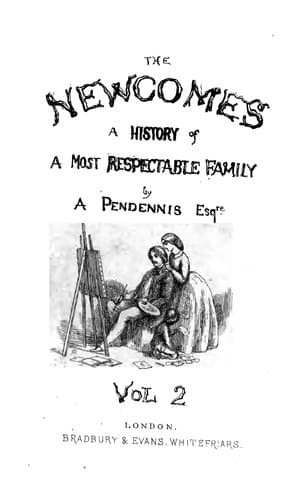
The Newcomes: Memoirs of a Most Respectable FamilyThackeray, William Makepeace
General
The Newcomes: Memoirs of a Most Respectable Family
Thackeray, William Makepeace
Domestic fiction; Families -- England -- Fiction
“_Salve, spes fidei, lumen ecclesiæ_,” he will say; “here’s towards
you, my buck. I knows the tap. Sherrick’s Marsala bottled three months
after date, at two hundred and forty-six shillings the dozen.”
“Indeed, indeed it’s not” (and now we are coming to an idea of the
skeleton in poor Honeyman’s closet—not that this huge handsome jolly
Fred Bayham is the skeleton, far from it. Mr. Frederick weighs fourteen
stone). “Indeed, indeed it isn’t, Fred, I’m sure,” sighs the other.
“You exaggerate, indeed you do. The wine is not dear, not by any means
so expensive as you say.”
“How much a glass, think you?” says Fred, filling another bumper. “A
half-crown, think ye?—a half-crown, Honeyman? By cock and pye, it is
not worth a bender.” He says this in the manner of the most celebrated
tragedian of the day. He can imitate any actor, tragic or comic; any
known Parliamentary orator or clergyman; any saw, cock, cloop of a cork
wrenched from a bottle and guggling of wine into the decanter
afterwards, bee buzzing, little boy up a chimney, etc. He imitates
people being ill on board a steam-packet so well that he makes you die
of laughing: his uncle the Bishop could not resist this comic
exhibition, and gave Fred a cheque for a comfortable sum of money; and
Fred, getting cash for the cheque at the Cave of Harmony, imitated his
uncle the Bishop and his Chaplain, winding up with his Lordship and
Chaplain being unwell at sea—the Chaplain and Bishop quite natural and
distinct.
“How much does a glass of this sack cost thee, Charley?” resumes Fred,
after this parenthesis. “You say it is not dear. Charles Honeyman, you
had, even from your youth up, a villainous habit. And I perfectly well
remember, sir, in boyhood’s breezy hour, when I was the delight of his
school, that you used to tell lies to your venerable father. You did,
Charles. Excuse the frankness of an early friend, it’s my belief you’d
rather lie than not. Hm”—he looks at the cards in the chimney-glass
“Invitations to dinner, proffers of muffins. Do lend me your sermon.
Oh, you old impostor! you hoary old Ananias! I say, Charley, why
haven’t you picked out some nice girl for yours truly? One with lauds
and beeves, with rents and consols, mark you? I have no money, ’tis
true, but then I don’t owe as much as you. I am a handsomer man than
you are. Look at this chest” (he slaps it), “these limbs; they are
manly, sir, manly.”
“For Heaven’s sake, Bayham,” cries Mr. Honeyman, white with terror; “if
anybody were to come——”
“What did I say anon, sir? that I was manly, ay, manly. Let any
ruffian, save a bailiff, come and meet the doughty arm of Frederick
Bayham.”
“Oh, Lord, Lord, here’s somebody coming into the room!” cries Charles,
sinking back on the sofa, as the door opens.
“Ha! dost thou come with murderous intent?” and he now advances in an
approved offensive attitude. “Caitiff, come on, come on!” and he walks
off with a tragic laugh, crying, “Ha, ha, ha, ’tis but the slavey!”
Public-domain text, read in full here on John Shaqi.
Reviews
Reviews
No reviews yet
Be the first to share your thoughts on this work.
Elsewhere in the archive
Join the Discussion
Join the discussion
Sign in to leave a comment or review.
Sign InorCreate an account