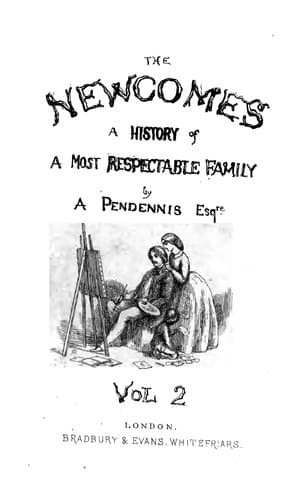
The Newcomes: Memoirs of a Most Respectable FamilyThackeray, William Makepeace
General
The Newcomes: Memoirs of a Most Respectable Family
Thackeray, William Makepeace
Domestic fiction; Families -- England -- Fiction
The slavey has Mr. Frederick’s hot water, and a bottle of sodawater on
the same tray. He has been instructed to bring soda whenever he hears
the word slavey pronounced from above. The bottle explodes, and
Frederick drinks, and hisses after his drink as though he had been all
hot within.
“What’s o’clock now, slavey—half-past three? Let me see, I breakfasted
exactly ten hours ago, in the rosy morning, off a modest cup of coffee
in Covent Garden Market. Coffee, a penny; bread, a simple halfpenny.
What has Mrs. Ridley for dinner?”
“Please, sir, roast pork.”
“Get me some. Bring it into my room, unless, Honeyman, you insist upon
my having it here, kind fellow!”
At the moment a smart knock comes to the door, and Fred says, “Well,
Charles, it may be a friend or a lady come to confess, and I’m off; I
knew you’d be sorry I was going. Tom, bring up my things; brush ’em
gently, you scoundrel, and don’t take the nap off. Bring up the roast
pork, and plenty of apple-sauce, tell Mrs. Ridley, with my love; and
one of Mr. Honeyman’s shirts, and one of his razors. Adieu, Charles!
Amend! Remember me.” And he vanishes into the upper chambers.
CHAPTER XII.
In which everybody is asked to Dinner
John James had opened the door hastening to welcome a friend and
patron, the sight of whom always gladdened the youth’s eyes; no other
than Clive Newcome—in young Ridley’s opinion, the most splendid,
fortunate, beautiful, high-born, and gifted youth this island
contained. What generous boy in his time has not worshipped somebody?
Before the female enslaver makes her appearance, every lad has a friend
of friends, a crony of cronies, to whom he writes immense letters in
vacation, whom he cherishes in his heart of hearts; whose sister he
proposes to marry in after life; whose purse he shares; for whom he
will take a thrashing if need be: who is his hero. Clive was John
James’s youthful divinity: when he wanted to draw Thaddeus of Warsaw, a
Prince, Ivanhoe, or some one splendid and egregious, it was Clive he
took for a model. His heart leapt when he saw the young fellow. He
would walk cheerfully to Grey Friars, with a letter or message for
Clive, on the chance of seeing him, and getting a kind word from him,
or a shake of the hand. An ex-butler of Lord Todmorden was a pensioner
in the Grey Friars Hospital (it has been said that at that ancient
establishment is a college for old men as well as for boys), and this
old man would come sometimes to his successor’s Sunday dinner, and
grumble from the hour of that meal until nine o’clock, when he was
forced to depart, so as to be within Grey Friars’ gates before ten;
grumble about his dinner—grumble about his beer—grumble about the
number of chapels he had to attend, about the gown he wore, about the
master’s treatment of him, about the want of plums in the pudding, as
old men and schoolboys grumble. It was wonderful what a liking John
James took to this odious, querulous, graceless, stupid, and snuffy old
Public-domain text, read in full here on John Shaqi.
Reviews
Reviews
No reviews yet
Be the first to share your thoughts on this work.
Elsewhere in the archive
Join the Discussion
Join the discussion
Sign in to leave a comment or review.
Sign InorCreate an account