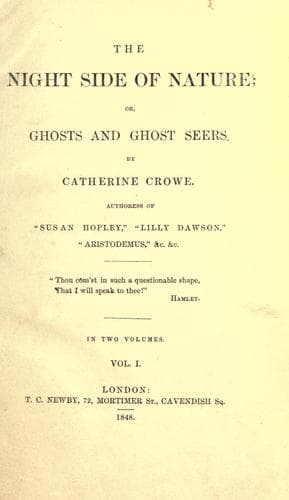
The Night-Side of Nature; Or, Ghosts and Ghost-SeersCrowe, Catherine
Religion
The Night-Side of Nature; Or, Ghosts and Ghost-Seers
Crowe, Catherine
Ghosts; Parapsychology
But to return once more to our own subject. If we do believe that a
future life awaits us, there can be nothing more natural than the desire
to obtain some information as to what manner of life that is to be for
which any one of us may, before this time to-morrow, have exchanged his
present mode of being. That there does not exist a greater interest with
regard to this question in the mind of man, arises partly from the
vague, intangible kind of belief he entertains of the fact; partly from
his absorption in worldly affairs, and the hard and indigestible food
upon which his clerical shepherds pasture him—for, under dogmatic
theology, religion seems to have withered away to the mere husk of
spiritualism; and partly, also, from the apparent impossibility of
pursuing the inquiry to any purpose. As I said before, observation and
experience can alone guide us in such an inquiry; for, though most
people have a more or less intuitive sense of their own immortality,
intuition is silent as to the mode of it; and the question I am anxious
here to discuss with my readers is, whether we have any facts to
observe, or any experience from which, on this most interesting of all
subjects, a conclusion may be drawn. Great as the difficulty is of
producing evidence, it will, I think, be pretty generally admitted that,
although each individual case, as it stands alone, may be comparatively
valueless, the amount of recurrent cases forms a body of evidence that,
on any other subject, would scarcely be rejected; and since, if the
facts are accepted, they imperatively demand an explanation—for,
assuredly, the present theory of spectral illusions can not comprise
them—our inquiry, let it terminate in whatever conclusion it may, can
not be useless or uninteresting. Various views of the phenomena in
question may be taken; and although I shall offer my own opinions and
the theories and opinions of others, I insist upon none. I do not write
to dogmatise, but to suggest reflection and inquiry. The books of Dr.
Ferriar, Dr. Hibbert, and Dr. Thatcher, the American, are all written to
support one exclusive theory; and they only give such cases as serve to
sustain it. They maintain that the whole phenomena are referrible to
nervous or sanguineous derangement, and are mere subjective illusions;
and whatever instance can not be covered by this theory, they reject as
false, or treat as a case of extraordinary coincidence. In short, they
arrange the facts to their theory, not their theory to the facts. Their
books can not, therefore, claim to be considered as anything more than
essays on a special disease; they have no pretence whatever to the
character of investigations. The question, consequently, remains as much
an open one as before they treated it; while we have the advantage of
their experience and information, with regard to the peculiar malady
that forms the subject of their works. On that subject it is not my
Public-domain text, read in full here on John Shaqi.
Reviews
Reviews
No reviews yet
Be the first to share your thoughts on this work.
Join the Discussion
Join the discussion
Sign in to leave a comment or review.
Sign InorCreate an account