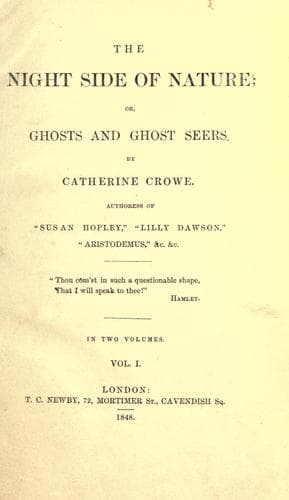
The Night-Side of Nature; Or, Ghosts and Ghost-SeersCrowe, Catherine
Religion
The Night-Side of Nature; Or, Ghosts and Ghost-Seers
Crowe, Catherine
Ghosts; Parapsychology
intention to enter; it is a strictly medical one, and every information
may be obtained respecting it in the above-named treatises, and others
emanating from the faculty.
The subjects I do intend to treat of are the various kinds of prophetic
dreams, presentiments, second-sight, and apparitions; and, in short, all
that class of phenomena which appears to throw some light on our
physical nature, and on the probable state of the soul after death. In
this discussion, I shall make free use of my German authorities, Doctors
Kerner, Stilling, Werner, Eschenmayer, Ennemoser, Passavent, Schubert,
Von Meyer, &c., &c.; and I here make a general acknowledgment to that
effect, because it would embarrass my book too much to be constantly
giving names and references, although, when I quote their words
literally, I shall make a point of doing so; and because, also, that, as
I have been both thinking and reading much on these subjects for a
considerable time past, I am, in fact, no longer in a condition to
appropriate, either to them or to myself, each his own. This, however,
is a matter of very little consequence, as I am not desirous of claiming
any idea as mine that can be found elsewhere. It is enough for me, if I
succeed in making a tolerably clear exposition of the subject, and can
induce other people to reflect upon it.
CHAPTER II.
THE DWELLER IN THE TEMPLE.
IT is almost needless to observe, that the Scriptures repeatedly speak
of man as a tripartite being, consisting of spirit, soul, and body: and
that, according to St. Paul, we have two bodies—a natural body and a
spiritual body; the former being designed as our means of communication
with the external world—an instrument to be used and controlled by our
nobler parts. It is this view of it, carried to a fanaticism, which has
led to the various and extraordinary mortifications recorded of
ascetics. As is remarked by the Rev. Hare Townshend, in a late edition
of his book on mesmerism, in this fleshly body consists our organic
life; in the body which we are to retain through eternity, consists our
fundamental life. May not the first, he says, “be a temporary
development of the last, just as leaves, flowers, and fruits, are the
temporary developments of a tree? And in the same manner that these pass
and drop away, yet leave the principle of reproduction behind, so may
our present organs be detached from us by death, and yet the ground of
our existence be spared to us continuously.”
Public-domain text, read in full here on John Shaqi.
Reviews
Reviews
No reviews yet
Be the first to share your thoughts on this work.
Join the Discussion
Join the discussion
Sign in to leave a comment or review.
Sign InorCreate an account