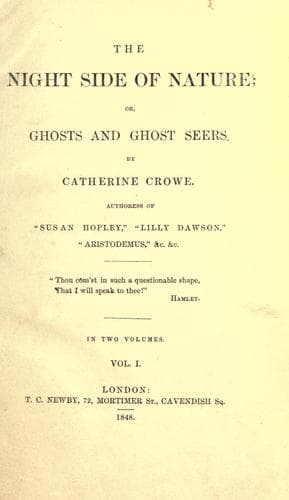
The Night-Side of Nature; Or, Ghosts and Ghost-Seers — John Shaqi
The Night-Side of Nature; Or, Ghosts and Ghost-SeersCrowe, Catherine
Religion
The Night-Side of Nature; Or, Ghosts and Ghost-Seers
Crowe, Catherine
Ghosts; Parapsychology
Without entering into the subtle disputes of philosophers, with regard
to the spirit, a subject on which there is a standing controversy
between the disciples of Hegel and those of other teachers, I need only
observe that the Scriptures seem to indicate what some of the heathen
sages taught, that the spirit that dwells within us is the spirit of
God, incorporated in us for a period, for certain ends of his own, to be
thereby wrought out. What those ends are, it does not belong to my
present subject to consider. In this spirit so imparted to us, dwells,
says Eschenmayer, the conscience, which keeps watch over the body and
the soul, saying, “Thus shalt thou do!” And it is to this Christ
addresses himself when he bids his disciples become perfect, like their
Father in heaven. The soul is subject to the spirit; and its functions
are, _to will_, or _choose_, _to think_, and _to feel_, and to become
thereby cognizant of the true, the beautiful, and the good;
comprehending the highest principle, the highest ideal, and the most
perfect happiness. The _Ego_, or _I_, is the resultant of the three
forces, Pneuma, Psyche, Soma—spirit, soul, and body.
In the spirit or soul, or rather in both conjoined, dwells, also, the
power of _spiritual seeing_, or _intuitive knowing_; for, as there is a
spiritual body, there is a spiritual eye, and a spiritual ear, and so
forth; or, to speak more correctly, all these sensuous functions are
comprised in one universal sense, which does not need the aid of the
bodily organs; but, on the contrary, is most efficient when most freed
from them. It remains to be seen whether, or in what degree, such
separation can take place during life; complete it can not be till
death; but whoever believes sincerely that the divine spirit dwells
within him, can, I should think, find no difficulty in conceiving that,
although from the temporary conditions to which that spirit is
subjected, this universal faculty is limited and obscured, it must still
retain its indefeasible attribute.
We may naturally conclude that the most perfect state of man on earth
consists in the most perfect unity of the spirit and the soul; and to
those who in this life have attained the nearest to that unity will the
entire assimilation of the two, after they are separated from the body,
be the easiest; while to those who have lived only their intellectual
and external life, this union must be extremely difficult, the soul
having chosen its part with the body, and divorced itself, as much as in
it lay, from the spirit. The voice of conscience is then scarcely heard;
and the soul, degraded and debased, can no longer perform its functions
of discerning the true, the beautiful, and the good.
Public-domain text, read in full here on John Shaqi.
Reviews
Reviews
No reviews yet
Be the first to share your thoughts on this work.
Join the Discussion
Join the discussion
Sign in to leave a comment or review.
Sign InorCreate an account