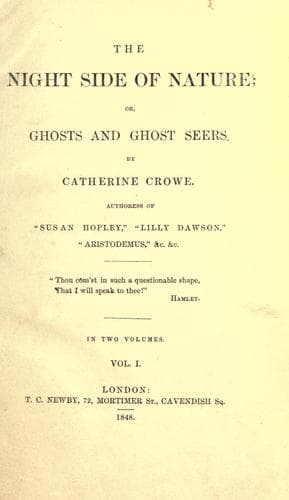
The Night-Side of Nature; Or, Ghosts and Ghost-SeersCrowe, Catherine
Religion
The Night-Side of Nature; Or, Ghosts and Ghost-Seers
Crowe, Catherine
Ghosts; Parapsychology
Somewhat analogous to this sort of double life is the case of the young
girl mentioned by Dr. Abercrombie and others, whose employment was
keeping cattle, and who slept for some time, much to her own annoyance,
in the room adjoining one occupied by an itinerant musician. The man,
who played exceedingly well, being an enthusiast in his art, frequently
practised the greater part of the night, performing on his violin very
complicated and difficult compositions; while the girl, so far from
discovering any pleasure in his performances, complained bitterly of
being kept awake by the noise. Some time after this, she fell ill, and
was removed to the house of a charitable lady, who undertook the charge
of her; and here, by-and-by, the family were amazed by frequently
hearing the most exquisite music in the night, which they at length
discovered to proceed from the girl. The sounds were those of a violin,
and the tuning and other preliminary processes were accurately imitated.
She went through long and elaborate pieces, and afterward was heard
imitating, in the same way, the sounds of a pianoforte that was in the
house. She also talked very cleverly on the subjects of religion and
politics, and discussed with great judgment the characters and conduct
of persons, public and private. Awake, she knew nothing of these things;
but was, on the contrary, stupid, heavy, and had no taste whatever for
music. Phrenology would probably interpret this phenomenon by saying
that the lower elements of the cerebral spinal axis, as organs of
sensation, &c., &c., being asleep, the cluster of the higher organs
requisite for the above combinations were not only awake, but rendered
more active from the repose of the others: but to me it appears that we
here see the inherent faculties of the spirit manifesting themselves,
while the body slept. The same faculties must have existed when it was
in a waking state, but the impressions and manifestations were then
dependent on the activity and perfection of the sensuous organs, which
seem to have been of an inferior order; and consequently, no rays of
this in-dwelling genius could pierce the coarse integument in which it
was lodged.
Public-domain text, read in full here on John Shaqi.
Reviews
Reviews
No reviews yet
Be the first to share your thoughts on this work.
Join the Discussion
Join the discussion
Sign in to leave a comment or review.
Sign InorCreate an account