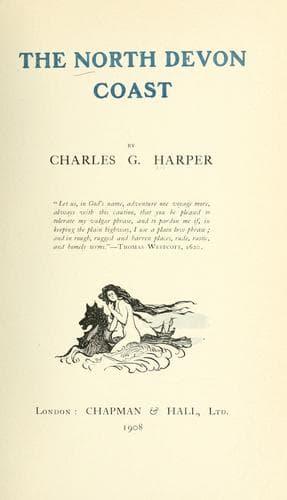
The North Devon CoastHarper, Charles G. (Charles George)
History
The North Devon Coast
Harper, Charles G. (Charles George)
Devon (England) -- Description and travel
The tiny bay that opens out from this twilight lane is a quiet spot,
where boulders are scattered about amid the sand and shingle, with that
look of studied abandon customary in stage-carpenters’ versions of the
seaside; and surely we can give no higher praise than that! It is a
spot where one might fitly converse with some not too forward young
mermaid (keep your eye off her tail, and such, by all accounts, should
be presentable enough); to be auditor of strange, uncanny legends; a
thousand fearful wrecks “full fathom five,” and dead-men’s bones and
drowned treasure.
But for tales of drowned treasure, or “money sunk” and lost, which,
after all, is much the same to the owner of it--one need not go far,
nor seek the dangerous society of mermaids. Wooda Bay, yonder, across
the intervening neck of land, has a modern story of some interest.
It was somewhere about 1895 that Benjamin Greene Lake, of the London
firm of solicitors, Lake and Lake, conceived the idea of “developing”
this secluded and extremely lovely spot, and of making it, as it
were, a newer Lynmouth. He purchased much land, caused many roads to
be made to the bay, and built an elaborate timber landing-stage for
steamers. A few houses were indeed built here and there: among them the
“Glen” Hotel, but Wooda Bay has not developed to any extent, in the
building-estate sense. How many thousands of pounds were lost here,
seems uncertain; according to some accounts, £25,000, or by others,
much more. Unfortunately, this was one of Benjamin Greene Lake’s
many speculations financed with other people’s money--without their
knowledge or consent. He was sentenced in January 1901 to twelve years’
imprisonment, for converting trust funds to his own use. He had in
various projects made away with no less than £170,000 of his clients’
money.
So there was an end of this great development idea. Only a few
scattered houses and the roads gashed in the hill-tops remain to tell
of it, for the sea speedily washed away every fragment of the timber
pier.
The name of Wooda Bay, therefore, falls ill on the ears of not a
few defrauded persons. It is a pity, for it is one of the loveliest
bays on an exceptionally lovely coast. The Post Office authorities
have adopted the new-fangled spelling, “Woody,” instead of “Wooda,”
as appears by the tree-shaded post-office here; and the Lynton and
Barnstaple Railway, which has a station for it, set down in a far-off
wilderness, appears to spell the name, with a fine air of impartiality,
in both styles. But the old rustic Devonian way was “Wooda”; a form
characteristic of innumerable place-names throughout the country, and
exemplified near by, in “Parracombe,” “Challacombe,” “Fullaford,”
“Buzzacott,” and innumerable others.
Delightful lanes lead round the shores of the bay, amid woods, with
here and there a waterfall; notably at a point where a bridge carrying
a lane over a little stream is inscribed Inkerman Bridge, 1857.
Public-domain text, read in full here on John Shaqi.
Reviews
Reviews
No reviews yet
Be the first to share your thoughts on this work.
Join the Discussion
Join the discussion
Sign in to leave a comment or review.
Sign InorCreate an account