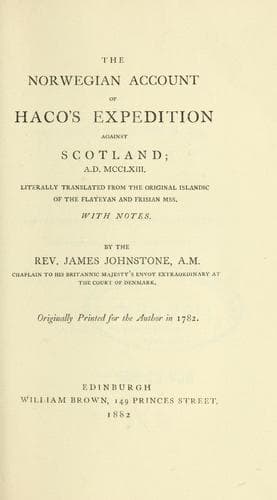
The Norwegian account of Haco's expedition against Scotland, A.D. MCCLXIII.Sturla Þórðarson
History
The Norwegian account of Haco's expedition against Scotland, A.D. MCCLXIII.
Sturla Þórðarson
Haakon IV Haakonsson, King of Norway, 1204-1263; Norway -- History -- 1030-1397; Scandinavians; Scotland -- History -- To 1603
King Haco had given orders that his remains should be carried east to
Norway, and buried near his Father and relations. Towards the end of
winter, therefore, that great vessel which he had had in the west was
launched, and soon got ready. On Ash-Wednesday the corpse of King Haco
was taken out of the ground; this happened on the third of the nones
of March. The Courtiers followed the corpse to Skalpeid where the ship
lay, and which was chiefly under the direction of Bishop Thorgisl, and
Andrew Plytt. They put to sea on the first Saturday in Lent; but
meeting with hard weather, they steered for Silavog.[104] From this
place they wrote letters to Prince Magnus acquainting him with the
news, and then set sail for Bergen. They arrived at Laxavog[105]
before the festival of St. Benedict.[106] On that day Prince Magnus
rowed out to meet the corpse. The ship was brought near to the King's
palace; and the body was carried up to a summer house. Next morning
the corpse was removed to Christ-church, and was attended by Prince
Magnus, the two Queens, the Courtiers, and the town's people. The body
was then interred in the Choir of Christ-church; and Prince Magnus
addressed a long and gracious speech to those who attended the
funeral procession. All the multitude present expressed great sorrow
of mind as Sturlas says.
22.
Three nights did the brave warriors, the flower of chivalry,
continue at Bergen, ere they entombed their wise and
glorious Prince. The breakers of temper'd metals, stood
crowding around the grave of the ruler of the nation, while
in their swimming eyes appear'd no look of joy.--Then
commenced those bloody feuds which till our days have
reigned.
King Haco was buried three nights before the festival of the
annunciation of the Virgin Mary; and after the Incarnation of our Lord
Jesus Christ one thousand two hundred and sixty three years.[107]
FINIS.
FOOTNOTES:
[Footnote 1: Sudr-eyiar, (_orig._). The Hebrides or southern division
of the Scottish islands, so called in contradistinction to the
Orkneys.]
[Footnote 2: Godred, Chrou-ban, _i.e._ the white handed, King of Man.]
[Footnote 3: _Th_ursa sker (_orig._) _i.e._ the giants' rocks,
Thurso.]
[Footnote 4: Solunder-haf, (_orig._) the Northern ocean. So called
from the Soloe islands near that promontory of Norway called Stad.
That species of sea fowl which frequent the Bass, probably received
their name from being more commonly found in the Solund isles.]
[Footnote 5: Kiarna-borg, (_orig._), _Fl. Ms._ Kianaborg, from the
Irish _carn_ a rock, and the Is. _borg_ a castle. This castle was
situated on a rocky islet near Mul. Fordun calls it Carnborg.]
[Footnote 6: Liod-hus, _i.e._ The residence of Liot. It is not
unlikely that the isle of Lewes, & the family of McLeod were so
named from Liod earl of Orkney.]
[Footnote 7: Kiarareyiar, in the Mss. Kiarbareyiar, the island
Kiararey where Alexander died, suddenly, Jul. 8th. 1249.]
Public-domain text, read in full here on John Shaqi.
Reviews
Reviews
No reviews yet
Be the first to share your thoughts on this work.
Join the Discussion
Join the discussion
Sign in to leave a comment or review.
Sign InorCreate an account