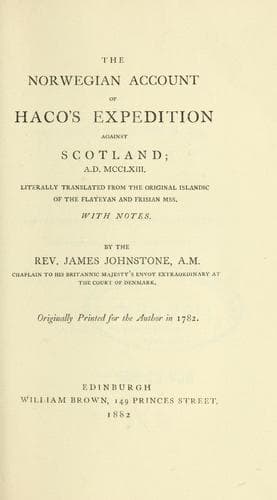
The Norwegian account of Haco's expedition against Scotland, A.D. MCCLXIII.Sturla Þórðarson
History
The Norwegian account of Haco's expedition against Scotland, A.D. MCCLXIII.
Sturla Þórðarson
Haakon IV Haakonsson, King of Norway, 1204-1263; Norway -- History -- 1030-1397; Scandinavians; Scotland -- History -- To 1603
[Footnote 8: Perhaps the Author means Frissel afterwards Bishop of St
Andrews; or Michael _viz._ de Weymyss, who was ambassador to Norway,
A. D. 1290.]
[Footnote 9: Jarlin af Ros ok Kiarnakr son Makamals (_orig._). The
text here is much vitiated. The author might have read in some Irish
accounts, Jarl na Ross (William) McKerchar, McCalom, _i.e._, the Earl
of Ross (William) the son of Ferchard, the son of Malcolm. This
William Mac Erchart was a young Hero, and is corruptly called
Macentagart by the Scottish historians. Or perhaps, three persons may
be alluded to, viz., the Earl of Ross, Kinneach-son (of Kintail), and
a MacCamal of Lochaw, all powerful chieftains on the west coast of
Scotland. It is, however, not impossible that Kiarnak was some ancient
chieftain from whom a branch of the Grants was called Clan-Chiarnach.
The Fl. Ms. for Makamals reads Machamals.]
[Footnote 10: I Skid (_orig._). In the Fl. Ms. istrid e. to war.]
[Footnote 11: The inhuman practice here described was common in those
times. From the Landnamaboc we learn that Olver first discouraged this
custom. We read, Olver did not permit tossing infants from spear to
spear as was usual among pirates, and was therefore surnamed
Barna-kall or the protector of Infants.]
[Footnote 12: Jol (_orig._). The great brumal festival among the
Scandinavians. Hence the Scotch word Yule, _i.e._, Christmas.]
[Footnote 13: Nid-ar-os (_orig._), _i.e._, the mouth of the river Nid,
now Drontheim.]
[Footnote 14: Vikor (_orig._), now Bahus in Sweden.]
[Footnote 15: Elfa, the river at Gottenburg.]
[Footnote 16: An Earl of Sweden and father-in-law to Haco the
younger.]
[Footnote 17: Liodhusa, a town of Sweden demolished A.D. 1268.]
[Footnote 18: May 3.]
[Footnote 19: _i.e._, the hilly country. Harald Harfager divided his
kingdom into several counties, each of which was to fit out a squadron
of ships on an emergency. The counties were again divided into
_skipreidor_, or smaller districts, each of which furnished a single
vessel properly equipped.]
[Footnote 20: _i.e._, an eminence, near Bergen.]
[Footnote 21: By banks of oars we are only to understand benches for
the rowers.]
[Footnote 22: _i.e._, Cape-bay, near Bergen.]
[Footnote 23: An island and excellent harbour near Bergen.]
[Footnote 24: A celebrated poet, uncle to Sigvat Bodvarson, who
attended Haco in this expedition, and from whom Sturla probably had
his information of facts.]
[Footnote 25: The most northerly province of Norway.]
[Footnote 26: _i.e._, no warrior.]
[Footnote 27: The Scandinavian Scalds and Mythologists often
represented treasures as guarded by monsters, dragons, sea snakes, &c.
This notion probably originated from the fabulous tales of those who
traded to the Indies. An ancient author, speaking of Scythia, says,
"nam qvum in plerisque locis auro & gemmis affluant, Gryphorum
immanitate, accessus hominum rarus est."]
[Footnote 28: _i.e._, Haco.]
[Footnote 29: _i.e._, ships.]
Public-domain text, read in full here on John Shaqi.
Reviews
Reviews
No reviews yet
Be the first to share your thoughts on this work.
Join the Discussion
Join the discussion
Sign in to leave a comment or review.
Sign InorCreate an account