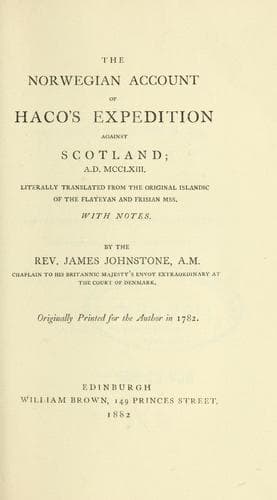
The Norwegian account of Haco's expedition against Scotland, A.D. MCCLXIII. — John Shaqi
The Norwegian account of Haco's expedition against Scotland, A.D. MCCLXIII.Sturla Þórðarson
History
The Norwegian account of Haco's expedition against Scotland, A.D. MCCLXIII.
Sturla Þórðarson
Haakon IV Haakonsson, King of Norway, 1204-1263; Norway -- History -- 1030-1397; Scandinavians; Scotland -- History -- To 1603
[Footnote 77: Skipa-fioerd in Islandic, and Loch-Lhong, in Gaelic,
signifies the Bay of Ships.]
[Footnote 78: Allan & Dougal his brother were, I imagine, the sons of
Rudri (see the note on page 34.) This Allan we may suppose to be the
same who, in Rymer's Foedera, is called "Alanus filius Rotherici," &
who A. D. 1284 was one of the Barons that engaged to support Margaret
of Norway's title to the crown of Scotland. Dugal was probably the
predecessor of McDougal of Dunoly _i.e._ Olave's tower. The place
might receive this name, from having been the residence of Olave, the
youngest Son of Somerled thane of Argyle.]
[Footnote 79: To avoid long, or dangerous circumnavigations, it was
usual for the antients to draw their light canoes over isthmuses.
Among the Greeks such places were termed [Greek: _diolchoi_] _i.e._
dragging-places, and there was a very remarkable one near Corinth. By
the Scotch they were called Tarbats, from the Gaelic _tarn_ to draw,
and _baat_ a boat. There was a Tarbat between Loch-Lomond and
Loch-Long.]
[Footnote 80: Alwin McArkel, as appears from the Chartulary of
Glasgow, was created Earl of Levnach by Maol-Coluim IIII., A. D.
1153.]
[Footnote 81: No doubt the neighbouring inhabitants retired to the
isles of Loch-Lomond in times of danger.]
[Footnote 82: _i.e._ Haco.]
[Footnote 83: _i.e._ without an awning.]
[Footnote 84: _i.e._ ships.]
[Footnote 85: _i.e._, the Scotch.]
[Footnote 86: Kerti-sveina (_orig._), _i.e._ Inspectors of the Lights,
who were to see that the Norwegian palace was properly illuminated.
The office corresponded exactly to the Canhowllyd of the Welsh
Princes.]
[Footnote 87: In the Fl. Ms. the Norwegians are said to have entered
the transport.]
[Footnote 88: Fl. MS., Five hundred.]
[Footnote 89: Perus or Pherus (_orig._), probably Fergus.]
[Footnote 90: A quotation from Giraldus's account of the Irish will
both illustrate this passage & the antient method of fighting.
"Utuntur--securibus quoque amplis, fabrili diligentia optime
chalybatis, quas a Norwegiensibus & Oustmannis sunt mutuati. Una
tantum manu, & non ambabus, securi percutiunt, pollice desuper
manubrium in longum extenso ictu regente, a quo nec galea, caput, in
conum erecta, nec reliquum corpus ferrea loricae tricatura tuetur. Unde
& in nostris contigit temporibus totam militis coxam ferro utcunque
fideliter vestitam, uno securis ictu praecisam fuisse, ex una equi
parte coxa cum tibia, ex altera vero, corpore cadente moribundo.
Lapides quoque pugillares, cum alia arma defecerint, hostibus in
conflictu damnosissimos, prae alia gente promptius, & expeditius ad
manum habent."]
[Footnote 91: Knights at their creation were invested with belts
ornamented with gems. See Malmsb., book 2, chap. 6.]
[Footnote 92: A district of Norway.]
[Footnote 93: Melanzeiar (_orig._). Fl. Ms. Melas eyiar, perhaps the
island of Lamlash or Alisa.]
Public-domain text, read in full here on John Shaqi.
Reviews
Reviews
No reviews yet
Be the first to share your thoughts on this work.
Join the Discussion
Join the discussion
Sign in to leave a comment or review.
Sign InorCreate an account