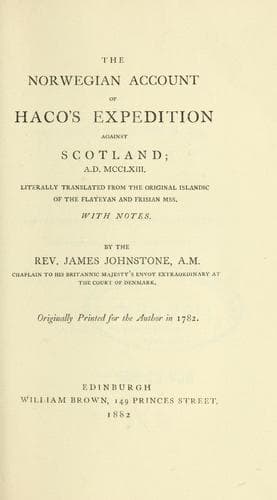
The Norwegian account of Haco's expedition against Scotland, A.D. MCCLXIII.Sturla Þórðarson
History
The Norwegian account of Haco's expedition against Scotland, A.D. MCCLXIII.
Sturla Þórðarson
Haakon IV Haakonsson, King of Norway, 1204-1263; Norway -- History -- 1030-1397; Scandinavians; Scotland -- History -- To 1603
[Footnote 59: Asleifarvik (_orig._). Fl. MS., Hals-eyiar-vic.]
[Footnote 60: _i.e._ The old woman's rock. _Cailleach_ in Irish, and
_kerling_ in Icelandic signify an old woman.]
[Footnote 61: _i.e._ The promontory. This island was so called
because, from its propinquity to the opposite shore, it appeared like
a cape. The old Venetian edition of Pliny has "Mella xxv mill. pass.
amplior proditur;" in the other copies it is "Reliquarum nulla" &c.
Hence the true reading appears to be Reliquarum Mulla &c.]
[Footnote 62: Ken-tir, _i.e._ the promontory, a Peninsula in Scotland,
Kintire.]
[Footnote 63: _i.e._ God's-Island. I take this to be Giga, or, as
Fordon calls it, Gia, compounded of the Gaelic _Dhia_, God, and the
Islandic _ey_, an island.]
[Footnote 64: Who this Margad was does not appear from history, I
believe.]
[Footnote 65: Angus, Lord of Kintire and Ila, was grandson & heir of
Reginald king of the isles. His posterity succeeded to the county of
Ross, & John, the second Earl, A.D. 1449, gave to his Brother Hugh the
Barony of Slate &c. Lord McDonald Baron of Slate, is the direct
male representative of Reginald.]
[Footnote 66: _i.e._, rings or bracelets.]
[Footnote 67: _i.e._, ships.]
[Footnote 68: _i.e._ the sea.]
[Footnote 69: A celebrated adventurer or sea king.]
[Footnote 70: Rudri or Ruari is the Irish abbreviation of Roderic. The
person here meant is, no doubt, the second son of King Reginald, & the
same who in a donation to the abbey of Sandale, is stiled Rodericus de
Kintire filius Reginaldi. This Roderic, it seems, besides Allan &
Dougal, had another son Angus McRorie, Lord of Bute, whose daughter
and heiress Jean was married to Alexander sixth Lord High Steward,
Grand father to Robert II. King of Scotland. Robert, A.D. 1400., gave
Bute to his son John from whom the present family of Bute is lineally
descended.]
[Footnote 71: _i.e._ the Scotch.]
[Footnote 72: _i.e._ the Scotch.]
[Footnote 73: _i.e._ sea.]
[Footnote 74: _i.e._ ships.]
[Footnote 75: Irar. (_orig._), _i.e._ Irish. As the native Irish had
suffer'd so much from the Scandinavians it is improbable they would
apply for assistance to the _Siol Lochlin na beum_. We may therefore
reasonably conclude that the People here mentioned were the
descendants of those Norwegians or Ostmen, who long inhabited the
eastern coast of Ireland and founded some of its best towns. A. D.
1201 those Ostmen or Easterlings were still so considerable that, at a
recognition taken of the diocese of Limerick, the arbitrators
consisted of 12 English, 12 Irish, & 12 Ostmen. Edw. I. gave
Gilchrist, William, & John Gilmorys, with other Ostmen in the County
of Waterford, peculiar privileges; &, by the rolls of Edw. II. they
evidently subsisted, as a distinct people, during the reign of that
prince.]
[Footnote 76: Kumr-eyiar (_orig._), _i.e._ the Islands of the
Cumbrians, two small islands to the West of Scotland.]
Public-domain text, read in full here on John Shaqi.
Reviews
Reviews
No reviews yet
Be the first to share your thoughts on this work.
Join the Discussion
Join the discussion
Sign in to leave a comment or review.
Sign InorCreate an account