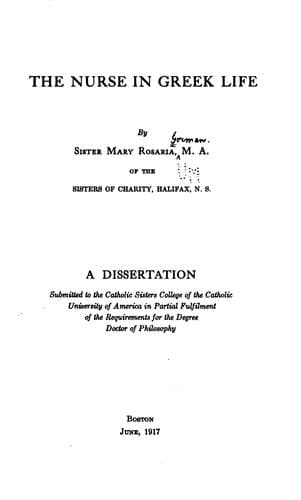
Greek literature -- History and criticism; Nurses; Thesis (Ph. D.)
When the nurse was not occupied with the child, she owed towards the
household, duties which are specifically mentioned in Homer; but not so
clearly defined in later authors. Thus the nurse of Eumaeus is engaged
in washing when she is seduced by the pirates.[178] Eurycleia is the
mainstay of the house in Ithaca, having complete charge of the domestic
arrangements. In the morning, she gives her directions for the day’s
work to the female slaves[179] over whom she has joint supervision with
the mistress.[180] These, she taught how to perform the various works of
the house—making beds, strewing couches, carding wool, setting tables
and cleaning rooms. Besides, she is the stewardess of the household:
ἐν δὲ γυνὴ ταμίη νύκτας τε καὶ ἦμαρ
ἔσχ’, ἣ πάντ’ ἐφύλασσε νόου πολυιδρείῃσιν,
Εὐρύκλει’, Ὦπος θυγάτηρ Πεισηνορίδαο.[181]
and to her Telemachus applies for provisions for his journey.[182] It is
characteristic of her to keep the best wine against the homecoming of
Odysseus.[183]
Demeter enumerates the duties incumbent on a nurse in addition to her
nursing cares:
οἷαί τε τροφοί εἰσι θεμιστοπόλων βασιλήων
παίδων καὶ ταμίαι κατὰ δώματα ἠχήεντα.
· · · · ·
... καὶ δώματα τηρήσαιμι,
καί κε λέχος στορέσαιμι μυχῷ θαλάμων εὐπήκτων
δεσπόσυνον, καὶ κ’ ἔργα διδασκήσαιμι γυναῖκας.[184]
They are substantially the same as those of Eurycleia.
So far as we can see, the nurse of Tragedy is occupied almost
exclusively with the mistress. The nurse of Medea, however, affects a
superior tone in speaking to the παιδαγωγός,[185] and gives him
directions concerning the children.[186] In a similar way the nurse of
Comedy seems to have authority over some of the servants.[187]
_General Characteristics of the Nurse_
Instances of the love and devotedness of nurses are not wanting in the
literature. From Homer down, we see the nurse as a kind mother lavishing
love and affection on the child that she nursed. In the Odyssey,
Eurycleia is represented as loving Telemachus more than did the other
women:
καὶ ἔτρεφε τυτθὸν ἐόντα.[188]
and Penelope bears witness that Eurycleia had diligently nursed and
tended Odysseus:
εὐ τρέφεν ἤδ’ ἀτίταλλε.[189]
Right willingly did the old nurse give her services to one who reminded
her of her master. She is the first to recognize him by the scar he had
received in his youth. Then
τὴν δ’ ἅμα χάρμα καὶ ἄλγος ἕλε φρένα, τὼ δέ οἱ ὄσσε
δακρυόφι πλῆσθεν, θαλερὲ δέ οἱ ἔσχετο φωνή.[190]
A picture of true devotedness is given by Herodotus,[191] where a nurse
takes an ugly child every day to the temple of Helen to implore the gift
of beauty for her charge.
Public-domain text, read in full here on John Shaqi.
Reviews
Reviews
No reviews yet
Be the first to share your thoughts on this work.
Join the Discussion
Join the discussion
Sign in to leave a comment or review.
Sign InorCreate an account