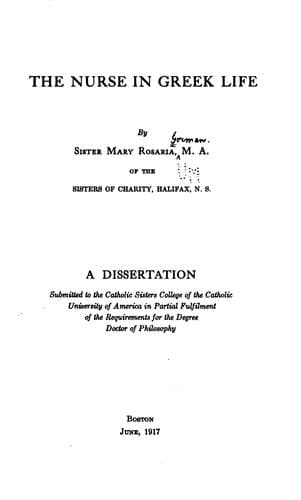
Greek literature -- History and criticism; Nurses; Thesis (Ph. D.)
Stesichorus[192] and Pindar[193] assert that it was the nurse who saved
Orestes from his mother after his father’s murder. Aeschylus calls her
Cilissa, and points her out to us as full of love and devotedness for
the child.[194] Such is the devotion of Medea’s nurse for her mistress
that the old παιδαγωγός is surprised to see her outside the place
without Medea.[195] The nurse in the Trachiniae shows real grief for the
fate of her mistress,[196] while Phaedra’s nurse attributes her unwise
action to excess of love,[197] and Hypsipyle’s nursling is as dear to
her as her own child.[198] Fidelity is the attribute which characterizes
Aristophanes’ πιστὴ τροφός.[199] A good instance of the nurse’s care for
the child is given in Menander, where an old nurse, seeing a child
crying and neglected, goes up to it and says: “My darling, and my
precious, and where is Mama?” She then kisses it and walks about with it
until it stops crying, when she says to herself, “Ah me, it seems but
yesterday I was nursing that dear child, Moschio, and now that a child
is born to him!” Then to a young girl who comes running in from outside:
“Bathe the child, can’t you? What is this? Is it because it is his
father’s wedding day that you have no care of the little one?”[200]
Examples of tender attachment are also met with in real life.
Demosthenes furnishes a typical illustration in Oration, xlvii. “I
explained to the interpreters the attachment of the woman to our family,
the cause of my having her in my house, and that she had lost her life
in the defense of my property. She had no kind of family connection with
me, except that she had been my nurse.”
Public-domain text, read in full here on John Shaqi.
Reviews
Reviews
No reviews yet
Be the first to share your thoughts on this work.
Join the Discussion
Join the discussion
Sign in to leave a comment or review.
Sign InorCreate an account