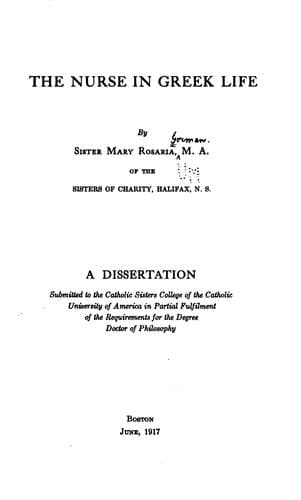
Greek literature -- History and criticism; Nurses; Thesis (Ph. D.)
Of the various terms employed in the literature to designate the nurse
we shall speak only of four: τροφός, τιθήνη, μαῖα, and τίτθη. The first
three are found in Homer[1] and the Hymns[2] with no apparent difference
of meaning. τίτθη is of later origin and is used of a wet-nurse by
Plato,[3] Demosthenes,[4] Aristotle,[5] Antiphanes,[6] Plutarch,[7]
Soranus.[8] The ancient lexicographers generally bear out this meaning
of the word. While Herodianus (I, 456, l. 2, Lentz), Hesychius and
Photius give τροφός as a synonym for τίτθη, Suidas defines it more at
length: τίτθαι, οὕτω καλοῦνται αἱ τοῖς τιτθίοις καὶ τῷ γάλακτι τρέφουσαι
τὰ παιδία. Eustathius[9] calls wet-nurses τίτθαι, and those who have the
care of children after weaning τιθηνοί and τροφοί: τίτθαι ... αἱ τοὺς
τιτθοὺς παρέχουσαι ... τιθηνοὶ δέ, ἔτι δὲ καὶ τροφοί ... αἱ τὸν ἄλλον
φασί, πόνον μετὰ τὸν ἀπογαλακτισμὸν ἀναεχόμεναι. Pollux defines τίτθαι
as αἱ θηλάζουσαι (II, 163) and again (III, 50) he says: τὴν δὲ
θηλάζουσαν Εὔπολις τίτθην θηλάστριαν ὠνόμασε. Between τιθήνη and τίτθη
he makes this distinction: ἡ δὲ τροφὸς τῆς κόρης, τιθήνη· καὶ ἡ γάλα
παρέχουσα τίτθη (III, 41). However, a writer of the second century A. D.
plainly referring to a wet-nurse, uses τίθηνη,
κοῦρος ὑπ’ ἐκ μαζοῖο τιθήνης
χείλεσιν αὖ ἐρύει λαρὸν γλάγος.[10]
The Etymologicum Magnum refers τιθήνη to τιτθόν: τιθήνας, τροφοὺς παρὰ
τὸ τιτθόν. According to Brugmann[11] τίτθη, τιθήνη, τίτθος are formed by
reduplication beside θήλη, “mother’s breast.”
As to the word τροφός, Herodianus (I, 225, l. 11, Lentz) refers it to
τρέφω. Hesychius[12] contrasts it with θρέμμα, “nursling.” Pollux
(l. c.) seems to distinguish τροφός and μαῖα and to take the latter as
meaning more strictly, “Ea quae lactat,” as Stephanus remarks in his
Thesaurus.
Various meanings were attached to the word μαῖα. Besides its use as
“mid-wife,” it was employed as a form of address in speaking to nurses:
εἰ δ’ ἄγε δή μοι, μαῖα φίλη.[13]
μαῖα, θεῶν μὲν δῶρα καὶ ἀχνύμενοι περ ἀνάγκῃ.[14]
μαῖα, πάλιν μου κρύψον κεφαλάν.[15]
The signification was even extended to embrace the true mother, as
attested by Euripides, Alcestis 393, where the child says of its mother:
μαῖα δὴ κάτω βέβακεν.
To distinguish accurately and sharply between the different words for
nurse is not our present purpose. Doubtless the differences between them
were not broad and clear even to the Greeks themselves. τροφός seems to
be employed as the generic term, while τίτθη is generally used for
“wet-nurse” and τροφός and τιθήνη for “nursery-maid.”
CHAPTER II
SOCIAL STATUS OF THE NURSE
_From Homer to Herodotus_
Public-domain text, read in full here on John Shaqi.
Reviews
Reviews
No reviews yet
Be the first to share your thoughts on this work.
Join the Discussion
Join the discussion
Sign in to leave a comment or review.
Sign InorCreate an account