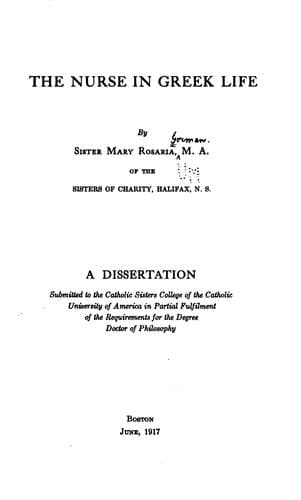
Greek literature -- History and criticism; Nurses; Thesis (Ph. D.)
The Homeric poems deal wholly with the life of the upper classes. Hence
we do not get from them a complete picture of how all classes lived.
Even for the aristocrat therein described, the habits of life were
simple. Mothers nursed their own children: thus Hecuba speaks to her
son, Hector:
Ἕκτορ, τέκνον ἐμόν, τάδε τ’ αἴδεο καὶ μ’ ἐλέησον
αὐτήν, εἴ ποτέ τοι λαθικηδέα μαζὸν ἐπέσχον.[16]
Still, there is one instance which points to a different practice.
Odysseus in addressing his old nurse Eurycleia says:
μαῖα, τίη μ’ ἐθέλεις ὀλέσαι; σὺ δέ μ’ ἔτρεφες αὐτὴ
τῷ σῷ ἐπὶ μαζῷ.[17]
The expression ἐπὶ μαζῷ here employed is used in another place of the
relation between mother and child:
πάις δέ οἱ ἦν ἐπὶ μαζῷ
νήπιος, ὅς που νῦν γε μετ’ ἀνδρῶν ἵζει ἀριθμῷ[18]
However this may be, nurses were employed as the attendants of the
children whom they amused and brought up as long as they remained in the
house of the parents.
Whatever function she performed, the Homeric nurse was a slave, either a
captive:
τήν ποτ’ Ἀπείρηθεν νέες ἤγαγον ἀμφιέλισσαι.[19]
or purchased as an ordinary slave:
τήν ποτε Λαέρτης πρίατο κτεάτεσσιν ἑοῖσι,
πρωθήβην ἔτ’ ἐοῦσαν, ἐεικοσάβοια δ’ ἔδωκεν.[20]
The Phrygian nurse of Hector’s son may be taken as a model of the Greek
nurse of an infant. Nothing is said as to her social standing, but we
infer from her occupation[21] that she was a slave.
The Phoenician woman, nurse to Eumaeus, gives us an instance of the
nurse of an older child. She had been captured and sold as a slave to a
master, whose hard bonds she feared:
ἀλλά μ’ ἀνήρπαξαν Τάφιοι ληίστορες ἄνδρες
ἀγρόθεν ἐρχομένην, πέρασαν δέ τε δεῦρ’ ἀγαγόντες
τοῦδ’ ἀνδρὸς πρὸς δώμαθ’· ὁ δ’ ἄξιον ὦνον ἔδωκε.
· · · · ·
μή τις ποτὶ δῶμα γέροντι
ἐλθὼν ἐξείπῃ, ὁ δ’ ὀϊσάμενος καταδήσῃ
δεσμῷ ἐν ἀργαλέῳ, ὑμῖν δ’ ἐπιφράσσετ’ ὄλεθρον.[22]
In striking contrast to this unfaithful slave is Eurycleia, the nurse of
the grown son, whose rank is higher than that of the ordinary slave, for
she had general supervision over the fifty female slaves of the
household and assisted the mistress in teaching them:
πεντήκοντά τοί εἰσιν ἐνὶ μεγάροισι γυναῖκες
δμωαί, τὰς μέν τ’ ἔργα διδάξαμεν ἐργάζεσθαι,
εἴριά τε ξαίνειν κὰι δουλοσύνην ἀνέχεσθαι.[23]
It is she, too, who fills the important office of ταμίη.[24] Indeed, she
is treated as a member of the family, is the friend and confidante of
the mistress who shows her great deference.[25]
The nurse of the grown daughter is seen in Eurymedusa who had been a
captive, the prize of King Alcinous.[26]
Penelope’s nurse, Eurynome, has much the same office as Eurycleia.[27]
Like her, she is a trusted slave devoted to her mistress.
Public-domain text, read in full here on John Shaqi.
Reviews
Reviews
No reviews yet
Be the first to share your thoughts on this work.
Join the Discussion
Join the discussion
Sign in to leave a comment or review.
Sign InorCreate an account