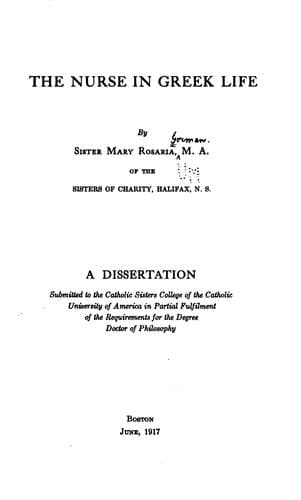
Greek literature -- History and criticism; Nurses; Thesis (Ph. D.)
But it was not only from Sparta that the Athenians obtained nurses for
their children. We have an inscription from the monument of the
Corinthian nurse Φάνιον.[52] And there is an epigram of Callimachus on a
Phrygian nurse whose master cared for her during her life-time, and when
she was dead set up her statue, that posterity might see how the old
woman received in full the thanks for her nurture.[53] Thrace, too,
furnished its share of types of nurses:
καί μ’ ἁ Θευχαρίδα Θρᾷσσα τροφὸς ἁ μακαρῖτις
ἀγχίθυρος ναίοισα, κατεύξατο καὶ λιτάνεσε
τὰν πομπὰν θάσασθαι.[54]
Such was the honor in which they were held that one Cleita was
considered worthy of a monument, as we learn from an epigram of
Theocritus:
ὁ μίκκος τόδ’ ἔτευξε τᾷ Θραΐσσᾳ,
Μήδειος τὸ μνᾶμ’ ἐπὶ τᾷ ὁδῷ κἠπέγραψε Κλείτας.[55]
The fact that the Greeks employed foreign nurses may also be inferred
from the essay, De Liberis Educandis, attributed to Plutarch, in which
the author loudly inveighs against the practice of entrusting children
to any nurse whatsoever. He insists on her being selected with the
utmost care, laying down as a fundamental qualification that she be of
the Greek race: ἀλλὰ τάς γε τίτθας καὶ τὰς τροφούς, οὐ τὰς τυχούσας,
ἀλλ’ ὡς ἔνι μάλιστα σπουδαίας, δοκιμαστέον ἐστί. πρῶτον μὲν τοῖς ἤθεσιν
Ἑλληνίδας.[56] According to the same author these women received wages
for their work: αἱ τίτθαι δὲ καὶ αἱ τροφοὶ τὴν εὔνοιαν ὑποβολιμαίαν καὶ
παρέγγραπτον ἔχουσιν, ἅτε μισθοῦ φιλοῦσαι.[57]
Such was the social status of this Greek nurse, a picture necessarily
composite since the details are drawn from so many sources; but from
what has been said, it may be concluded that the nurse, though usually a
slave, was sometimes manumitted, that a preference was frequently shown
at Athens for the foreign-bred nurse and that on occasion free women
resorted to nursing as a means of gaining a livelihood.
CHAPTER III
THE NURSE AND THE FAMILY
The helpless condition of infancy has always called for special offices
to tide the child over the first years of life. These offices are
performed either by mother or nurse. Among the Greeks, the nurse was a
familiar figure in the household; and although our knowledge of Greek
domestic life must necessarily be limited from the fact that the women’s
apartments are so persistently closed against us, nevertheless from
side-lights furnished by our threefold source of information—the
literature, the art and the inscriptions—we cannot help being impressed
by the important place which the nurse held in the family.
Let us now turn to a more exact consideration of the various duties of
the nurse in relation to the children, to the grown daughter, the grown
son and lastly to the household. In this way we shall be led to a
clearer conception of the general characteristics which marked the
nurse’s dealings with her charge.
Public-domain text, read in full here on John Shaqi.
Reviews
Reviews
No reviews yet
Be the first to share your thoughts on this work.
Join the Discussion
Join the discussion
Sign in to leave a comment or review.
Sign InorCreate an account