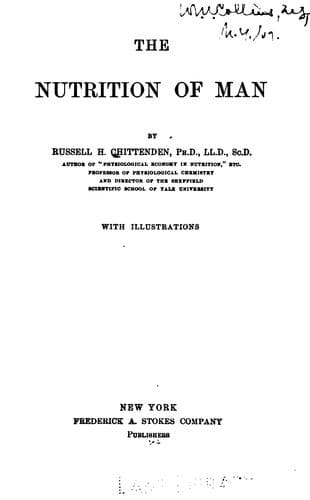
The nutrition of manChittenden, R. H. (Russell Henry)
Science
The nutrition of man
Chittenden, R. H. (Russell Henry)
Nutrition
Finally, we cannot avoid the conclusion that the outgoings of the body,
in the form of matter and energy, are subject to great variation,
incidental to the degree of activity of the day or hour. The ordinary
vicissitudes of life, bringing days of physical inaction, followed
perhaps by periods of unusual activity; changes in climatic conditions,
with their influence upon heat production in the body; alterations in
the character and amount of the daily dietary, etc.,--all seemingly
combine as natural obstacles to the maintenance of a true nutritive
balance. Outgo, however, must be met by adequate amounts of proper
intake if there is to be an approach toward a balance of nutrition.
In some way the normal, healthy man does maintain, approximately at
least, a condition of balance; not necessarily for every hour or for
every day, but the intake and outgo if measured for a definite period,
not too short, say for a week or two, will be found to approach each
other very closely. Body equilibrium and approximate nitrogen balance
may be reasonably looked for, as well as a balance of total energy, in
the case of a healthy man leading a life which conforms to ordinary
physiological requirements. The man who, on the other hand, consciously
or unconsciously, continues an intake way beyond the outgo, whose daily
income of nitrogen and total fuel value far exceeds the requirements
of his body, obviously lives with an accumulating plus balance, which
ordinarily shows itself in increasing body-weight and with a storing
away of fat.
Equally conspicuous is the effect of an inadequate income of proper
nutriment; a food supply which persistently fails to furnish the
available nitrogen and total energy value called for by the body under
the conditions prevailing, will inevitably result in a minus balance,
which, if continued too long, must of necessity tax the body’s store
to the danger limit. At the same time, the well-nourished individual,
without being unduly burdened by a bulky store of energy-containing
material, is always supplied with a sufficient surplus to meet all
rational demands, when from any cause the intake fails, for brief
periods of time, to be commensurate with the needs of the body. It is
reasonable to believe, however, that in the maintenance of good health,
and the preservation of a high degree of efficiency, the body should be
kept in a condition approaching a true nutritive balance.
CHAPTER IV
SOURCE OF THE ENERGY OF MUSCLE WORK, WITH SOME THEORIES OF PROTEID
METABOLISM
Public-domain text, read in full here on John Shaqi.
Reviews
Reviews
No reviews yet
Be the first to share your thoughts on this work.
Elsewhere in the archive
Join the Discussion
Join the discussion
Sign in to leave a comment or review.
Sign InorCreate an account