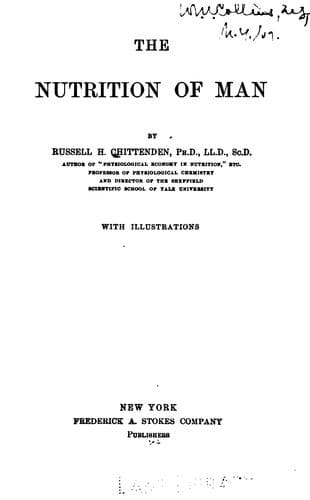
The nutrition of manChittenden, R. H. (Russell Henry)
Science
The nutrition of man
Chittenden, R. H. (Russell Henry)
Nutrition
The standards which have been adopted more or less generally throughout
the civilized world, based primarily on the assumption that man
instinctively and independently selects a diet that is best adapted
to his individual needs, are open to grave suspicion. The view that
the average food consumption of large numbers of individuals and
communities must represent the true nutritive requirements of the
people is equally untenable. Naturally, there is general recognition
of the principle that food requirements are necessarily modified by
a variety of circumstances, such as age, sex, body-weight, bodily
activity, etc. It is obvious that the man of 140 pounds body-weight
needs less proteid than the man of 170 pounds, and that the man who
does a large amount of physical work demands a larger calorific
value in his daily diet, _i. e._, more carbohydrate and fat, than
the sedentary individual. The growing child, in proportion to his
body-weight, plainly needs more proteid for the upbuilding of tissue,
and there are many conditions of disease where special dietetic
treatment is undoubtedly called for. Our contention, however, and one
which we believe to be perfectly justifiable, is that the true food
requirements of the body, under any conditions, cannot be ascertained
with any degree of accuracy by observations of what people are in the
habit of eating; that customs and habits are not a safe index of true
physiological needs. On the contrary, we are inclined to the belief
that direct physiological experimentation, covering a sufficient length
of time and with an adequate number of individuals, will prove far more
efficient in affording a true estimate of the quality and quantity of
food best adapted for the maintenance of good health, strength, and
vigor.
Public-domain text, read in full here on John Shaqi.
Reviews
Reviews
No reviews yet
Be the first to share your thoughts on this work.
Elsewhere in the archive
Join the Discussion
Join the discussion
Sign in to leave a comment or review.
Sign InorCreate an account