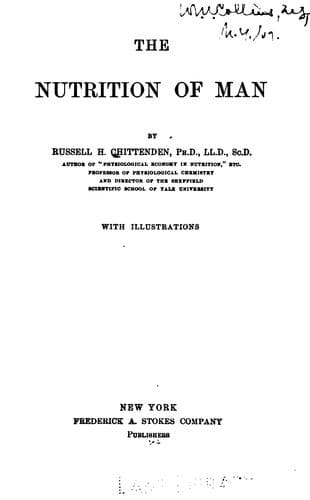
The nutrition of manChittenden, R. H. (Russell Henry)
Science
The nutrition of man
Chittenden, R. H. (Russell Henry)
Nutrition
Before considering these latter points, it is interesting to note, in
passing, that during the last four centuries many thoughtful men have
called attention to the apparent excessive use of food. There seems
to have been in many quarters a more or less prevalent opinion that
custom and habit were leading people on to methods of living, which
were not in accord with the best interests of the community. It must be
remembered, however, that arguments of this kind, even fifty years ago,
could have been founded only on general observation and the application
of common sense, since there were then no sound physiological data
on which to predicate an opinion, or base a conclusion. Still, there
were men of authority who attempted to lay before the people a proper
conception of the temperate use of food. We have not the time here to
consider many of these pleas, but I venture to call attention to the
somewhat celebrated book published by the physician Thomas Cogan in
1596, under the title “The Haven of Health,” and dedicated “to the
right honorable and my verie good lord, Sir Edward Seymour, Knight and
Earl of Hertford.” Under the subject of diet, this old-time writer
says: “The second thing that is to be considered of meates is the
quantitie, which ought of all men greatly to be regarded, for therein
lyeth no small occasion of health or sickness, of life or death. For
as want of meate consumeth the very substance of our flesh, so doth
excesse and surfet extinguish and suffocate naturall heat wherein life
consisteth.” Again, “Use a measure in eating, that thou maist live
long: and if thou wilst be in health, then hold thine hands. But the
greatest occasion why men passe the measure in eating, is varitie of
meats at one meale. Which fault is most common among us in England
farre above all other nations. For such is our custome by reason of
plentie (as I think) that they which be of abilitie, are served with
sundry sortes of meate at one meale. Yea the more we would welcome our
friends the more dishes we prepare. And when we are well satisfied with
one dish or two, then come other more delicate and procureth us by that
meanes, to eate more than nature doth require. Thus varietie bringeth
us to excesse, and sometimes to surfet also. But Phisicke teacheth
us to faede moderately upon one kinde of meate only at one meale, or
at leastwise not upon many of contrarie natures.... This disease, (I
mean surfet) is verie common: for common is that saying and most true:
That more die by surfet than by the sword. And as Georgius Pictorius
saith, all surfet is ill, but of bread worst of all. And if nature be
so strong in many, and they be not sicke upon a full gorge, yet they
are drowsie and heavie, and more desirous to loyter than to labor,
according to that old maeter, when the belly is full, the bones would
be at rest. Yea the minde and wit is so oppressed and overwhelmed with
excesse that it lyeth as it were drowned for a time, and unable to use
his force.”
Public-domain text, read in full here on John Shaqi.
Reviews
Reviews
No reviews yet
Be the first to share your thoughts on this work.
Elsewhere in the archive
Join the Discussion
Join the discussion
Sign in to leave a comment or review.
Sign InorCreate an account