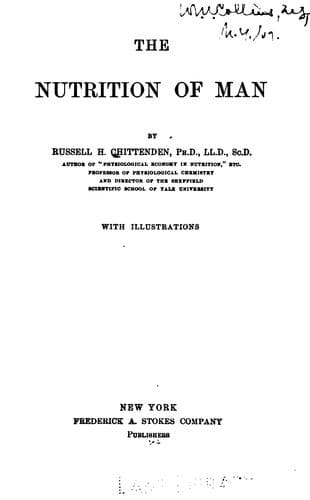
The nutrition of manChittenden, R. H. (Russell Henry)
Science
The nutrition of man
Chittenden, R. H. (Russell Henry)
Nutrition
Cogan likewise makes some interesting statements regarding the effects
of custom on the consumption of proteid food, especially meats. Quoting
further from this author: “The fourth thing that is to be considered
in meats is custome. Which is of such force in man’s bodie both in
sicknesse and in health, that it countervaileth nature itselfe, and is
therefore called of Galen in sundry places, an other nature. Whereof he
giveth a notable example, where he sheweth that an olde woman of Athens
used a long time, to eate Hemlocke (which is a ranke poison) first a
little quantitie, and afterwarde more, till at length she could eate so
much without hurt as would presently poison another.... So that custome
in processe of time may alter nature.” Finally, we may quote one last
saying of Cogan’s, because of the good sense and wisdom displayed
in the sentiment, as true to-day as when it was written more than
three hundred years ago: “Neither is it good for any man that is in
perfect health, to observe any custome in dyet precisely, as Arnoldus
teacheth upon the same verses in these wordes: Every man should so
order himselfe, that he might be able to suffer heate and cold, and
all motions, and meats necessary, so as he might change the houres of
sleeping and waking, and his dwelling and lodging without harme: which
thing may be done if we be not too precise in keeping custome, but
otherwise use things unwonted. Which sentence of Arnoldus agraeth verie
well to that of Cornelius Celsus: He that is sound and in good health,
and at libertie, should bind himselfe to no rules of dyet. To need
neither Phisition or Chirurgion, he must use a diverse order of life,
and be sometimes in the countrie, sometime in the towne, sometimes
hunt, and sometime hawke. But some man may demand of me how this may
agree with that saying of the scholar of Salernus ‘if you would be free
from physicians, let these three be your physician, a cheerful mind,
rest, and a moderate diet.’ Whereunto I answer, that a moderate dyet
is alwaies good, but not a precise dyet: for a moderate diet is, as
Terence speaketh in Andria: To take nothing too much: which alwaies
is to be observed. But if a man accustome himselfe to such meats and
drinks as at length will breed some inconvenience in his bodie, or to
sleepe or to watch, or any other thing concerning the order of his
life, such custome must naedes be amended and changed, yet with good
discretion, and not upon the sudden: because sudden changes bring harme
and weaknesse, as Hippocrates teacheth. He therefore that will alter
any custome in dyet rightly, must do it with three conditions, which
are expressed by Hippocrates. Change is profitable, if it be rightly
used, that is, if it be done in the time of health, and at leisure, and
not upon the sudden.”
Public-domain text, read in full here on John Shaqi.
Reviews
Reviews
No reviews yet
Be the first to share your thoughts on this work.
Elsewhere in the archive
Join the Discussion
Join the discussion
Sign in to leave a comment or review.
Sign InorCreate an account