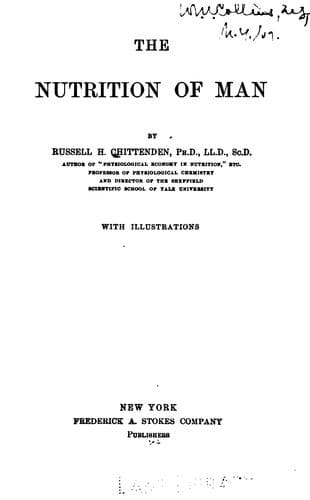
The nutrition of manChittenden, R. H. (Russell Henry)
Science
The nutrition of man
Chittenden, R. H. (Russell Henry)
Nutrition
[61] In presenting the general results of these experiments, the
writer has drawn freely from his book, “Physiological Economy in
Nutrition,” published by the Frederick A. Stokes Company, New York,
1904.
The detail was composed of a detachment of twenty men from the
Hospital Corps of the army, under the command of a first lieutenant
and assistant surgeon. They were located in a convenient house near
to the laboratory, where they lived during their six months’ stay in
New Haven, under military discipline, and subject to the constant
surveillance of the commanding officer and the non-commissioned
officers. Having well-trained cooks and assistants, with all necessary
facilities for preparing and serving their food, with members of
the laboratory staff to superintend the weighing of the food as it
was placed before the men, and with intelligent clerks to attend
to the many details connected with such an undertaking, a somewhat
unique physiological experiment was started. Thirteen members of the
detachment really took part in the experiment as subjects, and they
represented a great variety of types: of different ages, nationalities,
temperaments, and degrees of intelligence. They were men accustomed
to living an active life under varying conditions, and they naturally
had great liking for the pleasures of eating. Further, it should be
remembered that, although the men had volunteered for the experiment,
they had no personal interest whatever in the principles involved,
and it could not be expected that they would willingly incommode
themselves, or suffer any great amount of personal inconvenience.
Again, there were necessary restrictions placed upon their movements,
when relieved from duty, which constituted something of a hardship in
the minds of many of the men and added to the irksomeness and monotony
of their daily life. Regularity of life was insisted upon, and this
was a condition which brought to some of the men a new experience.
These facts are mentioned because their recital will help to make clear
that, from the standpoint of the men, there were certain depressing
influences connected with the experiment which would add to any
personal discomfort caused by restriction of diet.
The ordinary army ration to which these men were accustomed was rich in
proteid, especially in meat, and during the first few days they were
allowed to follow their usual dietary habits, in order that data might
be obtained bearing on their average food consumption. The details of
one day’s food intake will suffice to show the average character and
amount of the food eaten per man:
Breakfast.--Beefsteak 222 grams, gravy 68 grams, fried potatoes 234
grams, onions 34 grams, bread 144 grams, coffee 679 grams, sugar 18
grams.
Dinner.--Beef 171 grams, boiled potatoes 350 grams, onions 55 grams,
bread 234 grams, coffee 916 grams, sugar 27 grams.
Public-domain text, read in full here on John Shaqi.
Reviews
Reviews
No reviews yet
Be the first to share your thoughts on this work.
Elsewhere in the archive
Join the Discussion
Join the discussion
Sign in to leave a comment or review.
Sign InorCreate an account