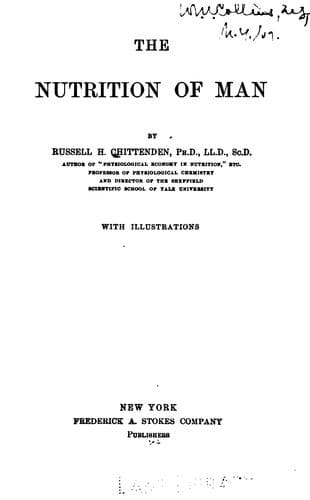
The nutrition of manChittenden, R. H. (Russell Henry)
Science
The nutrition of man
Chittenden, R. H. (Russell Henry)
Nutrition
The significance of such a conclusion is manifestly obvious. It
confirms and gives added force to the observations that man can
profitably maintain nitrogen equilibrium, and body-weight, upon a
much smaller amount of proteid food than he is accustomed to consume.
It harmonizes with the view that the normal requirements of the body
for food, under which health, strength, and maximum efficiency are
best maintained, are on a far lower level than the ordinary practices
of mankind would lead one to believe. The widespread opinion that
a rich proteid diet, with the correspondingly high rate of proteid
metabolism, is a necessity for the preservation of bodily strength and
vigor, is seen to be without foundation; for even the most conservative
estimate of the real value of these strength tests must carry with
it the conviction that lowering the consumption of proteid food does
not at least result in any weakening of the body. This is a fact of
vital importance, for it needs no argument to convince even the most
optimistic that while it might be possible to maintain body-weight
and nitrogen equilibrium on a small amount of proteid food, such a
form of physiological economy would not only be of no advantage to
the individual, but would be positively injurious if there was a
gradual weakening of the muscles of the body with decrease of physical
strength, vigor, and endurance.
Another fact to be emphasized in this connection was the conviction,
gradually acquired by many of the subjects, that they suffered
less from fatigue after vigorous muscular effort than formerly.
This was especially conspicuous in the case of Donahue, whose work
on the Varsity basket-ball team called for vigorous exercise. It is
interesting to note that this athlete, of 63 kilos body-weight, for the
last four months of the experiment showed an average daily katabolism
of 7.45 grams of nitrogen, corresponding to a breaking down of 46.5
grams of proteid material daily. Yet, with this low rate of proteid
exchange, he maintained his position on the team with satisfaction to
all, and with the consciousness of improved physical condition and
greater freedom from fatigue. Other subjects, as the laboratory workers
of the professional group, observed that the customary late afternoon
fatigue, coincident with the continued walking and standing about the
laboratory, gradually became far less conspicuous than usual; so that
there seemed to be a consensus of opinion that in some way the change
in diet was conducive to greater freedom from muscular weariness.
Public-domain text, read in full here on John Shaqi.
Reviews
Reviews
No reviews yet
Be the first to share your thoughts on this work.
Elsewhere in the archive
Join the Discussion
Join the discussion
Sign in to leave a comment or review.
Sign InorCreate an account