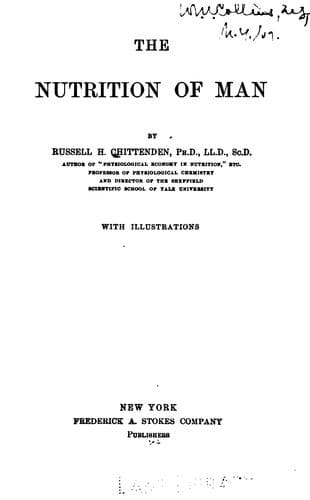
The nutrition of manChittenden, R. H. (Russell Henry)
Science
The nutrition of man
Chittenden, R. H. (Russell Henry)
Nutrition
It is well understood by physiologists that the ability of a muscle
to do work is inhibited by any condition that tends to depress the
general nutritive state of the body, or that interferes with the local
nutrition of the muscle or muscles involved. On the other hand, there
are certain well-recognized conditions that tend to augment the power
of the muscle, notably an increased circulation of blood through the
tissue, the taking of food, and especially the introduction of sugar.
Further, experiments have shown that when a given set of muscles has
been made to work excessively, other muscles of the body quite remote
will share in the fatigue, thus implying that muscular weariness and
the diminished power to do work are connected with what may be termed
fatigue products, which are distributed by means of the circulation. In
this way, muscles and nerve endings alike are exposed to the inhibitory
influence of waste products of unknown composition, formed in the
muscle, and as previously stated, we may conceive of an exaggerated
exogenous katabolism, with excessive proteid intake, by which muscular
fatigue and weariness may be augmented; hence, the beneficial effect in
this direction of a more rational food consumption, by which proteid
katabolism shall be reduced to a true physiological level.
With these marked effects on strength and fatigue, it is reasonable
to assume that some corresponding action may be exerted on physical
endurance. As is well known, strength and endurance, though related,
are quite distinct and can be separately measured. Strength tests,
however, as usually carried out in gymnasium work, do involve in
considerable degree the question of endurance, since it is customary to
use as one of the factors in estimating total strength the number of
times the man can pull up, or push up, his body on the parallel bars.
Strictly speaking, however, the strength of a muscle is measured by the
maximum force it can exert in a single contraction, while its endurance
is estimated from the number of times it can contract well within the
limit of its strength.
Public-domain text, read in full here on John Shaqi.
Reviews
Reviews
No reviews yet
Be the first to share your thoughts on this work.
Elsewhere in the archive
Join the Discussion
Join the discussion
Sign in to leave a comment or review.
Sign InorCreate an account