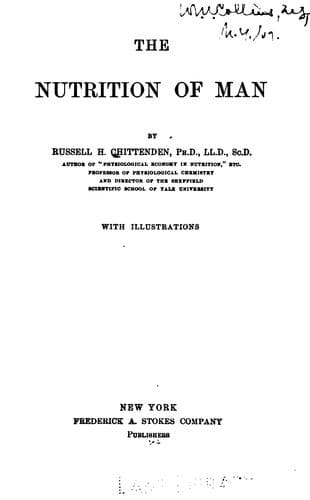
The nutrition of manChittenden, R. H. (Russell Henry)
Science
The nutrition of man
Chittenden, R. H. (Russell Henry)
Nutrition
As one looks through the many careful dietary studies that have been
made in recent years, it is easy to find striking illustrations of
people, and communities of people, who have lived for long periods
of time on dietaries so strikingly simple and meagre that it seems
difficult at first glance to believe their daily needs could have been
entirely satisfied. Yet, such observations are quite in accord with
the facts we have been presenting, and they afford additional evidence
that the artificial dietary standards that have been set up are widely
at variance with the real requirements of the body for food. It may
be quite true that many of the people referred to have been and are
faddists, with peculiar notions regarding food, based on religious or
other scruples, but that has no bearing on the main contention that
they have lived for many years on amounts of food ridiculously small
as compared with the ordinary customs of mankind. Thus, in Professor
Jaffa’s report[65] of investigations made among fruitarians and Chinese
of California is an interesting account of a dietary study of a family
of fruitarians, consisting of two women and three children. They had
all been fruitarians from five to seven years, their diet being limited
to nuts and fruit, except for the addition of celery, honey, olive
oil, and occasionally a small amount of prepared cereal food. This
family was in the habit of taking only two meals a day; at 10.30 in
the morning and at 5 o’clock in the afternoon. The first meal always
consisted of nuts and fruit, the nuts being eaten first. At the second
meal, nuts were usually replaced by olive oil and honey. The nuts made
use of were almonds, Brazil nuts, pine nuts, pignolias (a variety of
pine nuts), and walnuts. Fruits, both fresh and dried, were used,
the former including apples, apricots, bananas, figs, grapes, olives
(pickled), oranges, peaches, pears, plums, and tomatoes. The dried
fruits were dates and raisins.
[65] Bulletin No. 107, Office of Experiment Stations, U. S.
Department of Agriculture, 1901, from which the descriptions given
have been taken.
Public-domain text, read in full here on John Shaqi.
Reviews
Reviews
No reviews yet
Be the first to share your thoughts on this work.
Elsewhere in the archive
Join the Discussion
Join the discussion
Sign in to leave a comment or review.
Sign InorCreate an account