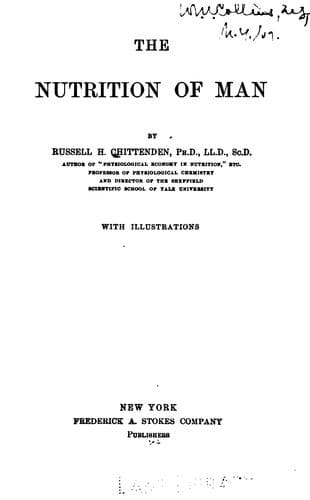
The nutrition of manChittenden, R. H. (Russell Henry)
Science
The nutrition of man
Chittenden, R. H. (Russell Henry)
Nutrition
In conclusion, the facts here presented bearing on food requirements,
especially those that relate to the need for proteid food, are
seemingly harmonious in indicating that the physiological necessities
of the body are fully met by a much more temperate use of food than is
commonly practised. Dietary standards based on the habits and usages
of prosperous communities are not in accord with the data furnished
by exact physiological experimentation. Nitrogen equilibrium can be
maintained on quantities of proteid food fully fifty per cent less
than the every-day habits of mankind imply to be necessary, and this
without increasing unduly the consumption of non-nitrogenous food. A
daily metabolism of proteid matter equal to an exchange of 0.10–0.12
gram of nitrogen per kilogram of body-weight is quite adequate for
physiological needs, provided a sufficient amount of non-nitrogenous
foods--fats and carbohydrates--is taken to meet the energy requirements
of the body.
The long-continued experiments on many individuals, representing
different types and degrees of activity, all agree in indicating that
equilibrium can be maintained indefinitely on these smaller quantities
of food, and that health and strength can be equally well preserved,
to say nothing of possible improvement. The lifelong experience of
individuals and of communities affords sufficient corroborative
evidence that there is perfect safety in a closer adherence to
physiological needs in the nutrition of the body, and that these needs,
so far as proteid food is concerned, are in harmony with the theory
of an endogenous metabolism, or true tissue metabolism, in which the
necessary proteid exchange is exceedingly limited in quantity. There
are many suggestions of improvement in bodily health, of greater
efficiency in working power, and of greater freedom from disease, in
a system of dietetics which aims to meet the physiological needs of
the body without undue waste of energy and unnecessary drain upon the
functions of digestion, absorption, excretion, and metabolism in
general; a system which recognizes that the smooth running of man’s
bodily machinery calls for the exercise of reason and intelligence, and
is not to be intrusted solely to the dictates of blind instinct or to
the leadings of a capricious appetite.
CHAPTER VII
THE EFFECT OF LOW PROTEID DIET ON HIGH PROTEID ANIMALS
Public-domain text, read in full here on John Shaqi.
Reviews
Reviews
No reviews yet
Be the first to share your thoughts on this work.
Elsewhere in the archive
Join the Discussion
Join the discussion
Sign in to leave a comment or review.
Sign InorCreate an account