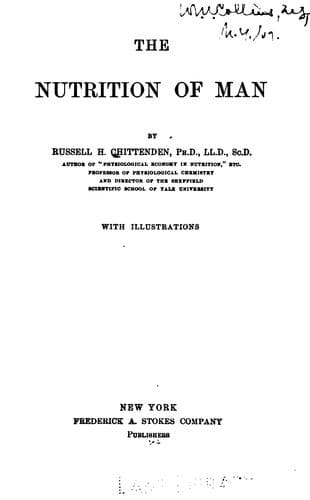
The nutrition of manChittenden, R. H. (Russell Henry)
Science
The nutrition of man
Chittenden, R. H. (Russell Henry)
Nutrition
A second experiment with a dog of 5.8 kilograms, fed on meat, fat, and
rice, led to essentially the same results as the preceding experiment.
At the end of the first month, there appeared indications that the
animal was not well, loss of appetite being marked, with disturbance
of the stomach accompanied by occasional vomiting. These symptoms
disappeared quickly when the animal was given for a few days large
quantities of meat. On returning to the original low proteid diet,
with its large content of rice, the symptoms gradually reappeared.
At the end of two months the animal had again lost its appetite, and
before the end of the fifth month the subject was dead. Post-mortem
examination showed especially a strong fatty degeneration of the
epithelial cells of the mucous membrane of the stomach and intestine.
Rosenheim concludes that a diet poor in proteid is unhealthful for
dogs, and that a daily ration containing even 0.32 gram of nitrogen
per kilogram of body-weight, and with a fuel value of 110 calories per
kilo, is not sufficient to maintain the animal in a condition of health.
The next series of experiments was made by Jägerroos[70] of Finland.
This investigator was evidently impressed by the unfavorable and
monotonous character of the diet made use of by the preceding
investigators, and sought to introduce a little variety, recognizing
also that with a carnivorous animal it is difficult to reduce the
proteid to a low level and maintain the necessary fuel value, without
introducing foodstuffs to which the animal is wholly unaccustomed. In
the first experiment, the dog had a body-weight of 5.77 kilograms, and
at the beginning was fed daily 40 grams of meat and 100 grams of sugar,
equal to 0.31 gram of nitrogen and 80 calories per kilo of body-weight.
The experiment continued for eight months, sugar being replaced in part
by butter, and occasionally bread, fat, and wheat meal being used in
proper amount to yield the given nitrogen and fuel values. During the
last five months, the intake of nitrogen per day averaged 0.29 gram
per kilo, with a fuel value amounting to 89 calories daily per kilo of
body-weight. During this period, the animal maintained a plus nitrogen
balance for a large part of the time. The experiment was then continued
for two months longer, with a gradual diminution in the nitrogen of the
food and in the fuel value, the animal dying at the end of the tenth
month.
[70] B. H. Jägerroos: Ueber die Folgen einer ausreichenden, aber
eiweissarmen Nahrung. Skandinavisches Archiv für Physiologie, Band
13, p. 375, 1902.
Public-domain text, read in full here on John Shaqi.
Reviews
Reviews
No reviews yet
Be the first to share your thoughts on this work.
Elsewhere in the archive
Join the Discussion
Join the discussion
Sign in to leave a comment or review.
Sign InorCreate an account