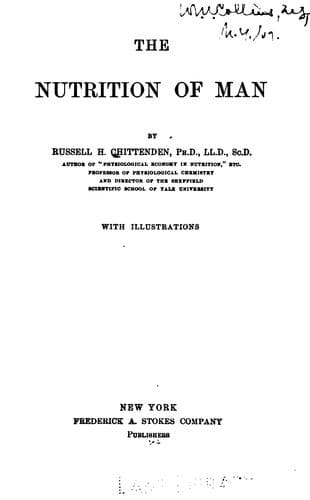
The nutrition of manChittenden, R. H. (Russell Henry)
Science
The nutrition of man
Chittenden, R. H. (Russell Henry)
Nutrition
It is doubtful if there is full appreciation of the possible effect
of monotony, in the ordinary dietary experiments on dogs. Man quickly
feels the effect; the sportsman camping in the woods by brook or lake
enjoys his first meal of speckled trout and has no thought of ever
becoming tired of such a delicacy; but as trout cooked in various ways
continue to be placed before him three times a day, and with perhaps
very little else, he soon passes into a frame of mind where salt pork
would be a luxury, and where he would prefer to go hungry rather than
eat the delicacy, if indeed he has appetite to eat anything. Is it
strange that dogs confined in cages barely large enough to permit of
their turning around, and fed day after day and month after month with
exactly the same amount of desiccated meat, fat, and rice, should show
signs and symptoms, if nothing worse, of disturbed nutrition? It is
necessary in experiments of this kind that the animals be confined
for given periods, at least, since otherwise it would be impossible
to determine the extent of nitrogen excretion and the rate of proteid
katabolism, etc. It is possible, however, to limit the time of close
confinement to, say, ten consecutive days, this to be followed by a
like period of comparative freedom, thus insuring opportunities for an
abundance of fresh air and exercise.
The experiments of which I wish to speak, and which had for their
object a study of the effect of low proteid diet on dogs, as types
of high proteid animals, were carried out at our laboratory in the
Sheffield Scientific School and were made possible by liberal grants
from the Carnegie Institution of Washington, thus providing means for
securing the requisite number of chemical assistants. The experiments
were conducted on a somewhat large scale, over twenty dogs being made
use of, while many of the experiments extended through a full year.
The results in their entirety are not yet ready for publication, but
I am able to present in a general way observations on six dogs, which
will serve as an ample illustration of what may be expected with high
proteid animals when living on a low proteid diet under healthful
conditions. All of the six dogs whose cases are here presented were fed
on a mixed diet, with some fresh meat each day; bread, cracker dust,
milk, lard, and rice being the other foods drawn upon to complete the
dietary. The animals were fed twice a day, each meal being accurately
weighed and of definite chemical composition. A large, light, and
airy room, kept scrupulously clean, and in the winter time properly
heated by steam, served as their main abiding place. In this room
were a suitable number of smaller compartments, the walls of which
were composed of open lattice work (of iron), so as not to interfere
with light or air, and yet adequate to keep the dogs apart. These
compartments were not cages in the ordinary sense, but were truly large
and roomy.
Public-domain text, read in full here on John Shaqi.
Reviews
Reviews
No reviews yet
Be the first to share your thoughts on this work.
Elsewhere in the archive
Join the Discussion
Join the discussion
Sign in to leave a comment or review.
Sign InorCreate an account