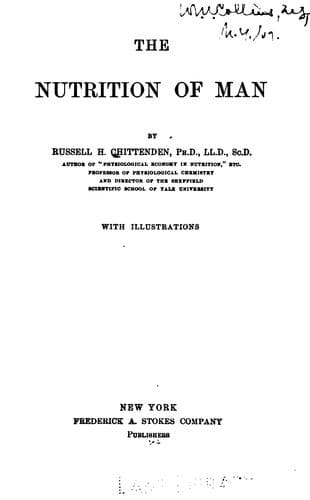
The nutrition of manChittenden, R. H. (Russell Henry)
Science
The nutrition of man
Chittenden, R. H. (Russell Henry)
Nutrition
Where expense must be carefully guarded, or where the condition of the
family purse is such that conflicting demands must be intelligently
considered in order to insure wise expenditure and the greatest
permanent good of the many, it is well to remember that price is no
guarantee whatever of real nutritive value. Two quarts of milk will
furnish half the daily fuel requirement of our average man and the
entire proteid requirement, while its cost is only sixteen cents.
Reinforced by a pound loaf of wheat bread, the energy requirement for
the day would be fully met, with surplus nitrogen to store up for
future needs, and at an additional cost of only ten cents. A mixture in
this proportion, however, would not be strictly physiological, since
it is wasteful of proteid, but it may serve to illustrate the point.
A better illustration is found in an admixture, quite adequate to
supply the daily needs of our average man, both for proteid and energy,
composed of one-quarter of a pound of lean beef, two-thirds of a pound
of bread, and half a pound of butter, and at a total cost not to exceed
thirty cents. The contrast of such prices with what is so commonly
paid for table delicacies is somewhat striking; it could be made still
more so by drawing upon many common vegetable foods, rich alike in
proteid and in fuel value, the cost of which is even less than the
simple food mixtures just referred to. It is not necessary, however, to
enlarge upon this question; it is sufficient to merely emphasize the
fact that the exaggerated demand of our present generation for dietetic
luxuries is leading us far away from the proverbially simple life of
our forefathers, and without adding in any way to the effectiveness of
the daily diet. On the contrary, it is in part responsible for the high
proteid consumption of the present day, with its attendant evils, and
involves a large and unnecessary expenditure without adequate return.
The wants of the body for food are far more advantageously met by a
simple dietary, moderate in amount and at an expense comparatively
slight.
A recent writer,[78] in the “British Medical Journal,” a practitioner
of medicine in the Highlands of Scotland, has said that these are
“facts of common experience in the Highlands of Scotland, and probably
among the peasantry of other countries also, where the old beliefs and
customs have not too readily given way to the luxuries of civilization.
Oatmeal in one form or another is a daily ingredient in the diet of a
Highland peasant. The potato also is a staple food, and is consumed in
large quantities with salt herring or other fish, and perhaps in some
cases salt mutton or pork. Milk and eggs are used by most. The growing
consumption of tea, however, and the increasing relish for sweets,
candy, pastry, and biscuits, threaten to destroy the old way of living.
A typical day’s diet for a crofter or fisherman who still believes in
the traditional diet would be somewhat like this:
Public-domain text, read in full here on John Shaqi.
Reviews
Reviews
No reviews yet
Be the first to share your thoughts on this work.
Elsewhere in the archive
Join the Discussion
Join the discussion
Sign in to leave a comment or review.
Sign InorCreate an account