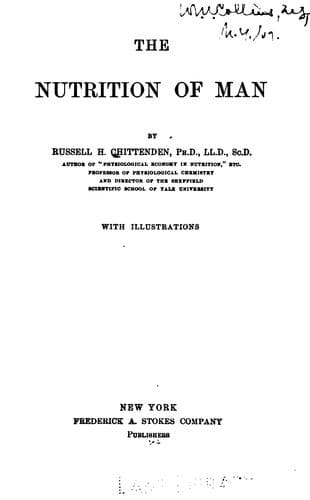
The nutrition of manChittenden, R. H. (Russell Henry)
Science
The nutrition of man
Chittenden, R. H. (Russell Henry)
Nutrition
As has been stated in several connections, a diet which conforms to the
true nutritive requirements of the body must necessarily lead toward
vegetable foods. In no other satisfactory way can excess of proteid be
avoided, and at the same time the proper calorific value be obtained.
This, however, does not mean vegetarianism, but simply a greater
reliance upon foods from the plant kingdom, with a corresponding
diminution in the typical animal foods. This raises the question of the
possible relation of diet to the bacterial processes of the intestine,
knowing, as we do, that the latter are of primary importance in the
causation of certain forms of auto-intoxication, etc. Recent studies
have indicated that the bacterial flora of carnivorous animals is
quite different from that of herbivorous animals, and this being so,
it is easy to see how a predominance of vegetable or animal food may
modify the bacterial conditions of the intestinal tract in man. Dr.
Herter[82] has reported the presence in the intestines of cats, dogs,
tigers, lion, and wolf of many spore-holding bacilli, as well as free
spores and vegetative forms of anærobic organisms; some of which at
least are decidedly pathogenic when injected into the subcutaneous
connective tissue, leading to serious and even fatal results within
twenty-four hours. With herbivorous animals, on the other hand, such as
the buffalo, goat, horse, elephant, etc., the predominating organisms
are of a different order from those found in the intestines of the
carnivora; proving practically non-pathogenic, or only slightly so,
when injected subcutaneously, and less disposed to produce putrefactive
changes or other chemical decompositions.
[82] C. A. Herter: Character of the Bacterial Flora of Carnivorous
and Herbivorous Animals. Science, December 28, 1906, p. 859.
Public-domain text, read in full here on John Shaqi.
Reviews
Reviews
No reviews yet
Be the first to share your thoughts on this work.
Elsewhere in the archive
Join the Discussion
Join the discussion
Sign in to leave a comment or review.
Sign InorCreate an account