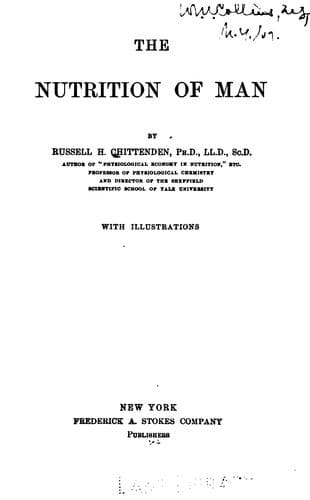
The nutrition of manChittenden, R. H. (Russell Henry)
Science
The nutrition of man
Chittenden, R. H. (Russell Henry)
Nutrition
In the words of Dr. Herter, “These differences in the appearance
and behavior of the bacteria derived from typical carnivora and
herbivora suggest that the habit of living upon a diet consisting
exclusively of raw meat entails differences in the types of bacteria
that characterize the contents of the large intestine. The occurrence
of considerable numbers of spore-bearing organisms in the carnivora
points to the presence of anærobic putrefactive forms in great
numbers. The results of subcutaneous inoculations into guinea-pigs
bear out this view and indicate that the numbers of organisms capable
of producing a hemorrhagic œdema with tissue necrosis, with or without
gas-production, are very considerable.... The observations recorded are
of much interest in relation to the bacterial processes and nutrition
of herbivorous as distinguished from carnivorous animals, and are
significant furthermore for the interpretation of bacterial conditions
found in man. The question arises whether the abundant use of meat over
a long period of time may not favor the development of much larger
numbers of spore-bearing putrefactive anærobes in the intestinal tract
than would be the case were a different type of proteid substituted for
meat.” While it may be said truly that observations of this character
are as yet not sufficiently numerous or conclusive to warrant positive
or sweeping statements, yet there is a suggestion here well worthy of
thoughtful consideration in its general bearing on the nutrition of
mankind.
Simplicity in diet, with or without complete abstinence from meat,
is often resorted to as a means of relief from bodily ailments, and
such cases sometimes afford striking illustrations of the adequacy
and benefits of a relatively low intake of food. Cases of this sort,
perhaps, are more frequently observed among elderly people, where the
daily requirements are not so great as with younger and more active
persons, but they offer evidence in support of our main thesis that
dietary habits are no guarantee of bodily requirements. I have in mind
the details of an exceedingly interesting case reported with much care
by Dr. Fenger;[83] the case of a man who at 61 years of age, after a
long period of poor health, brought himself quickly into a condition of
sound health by a daily diet characterized by extreme simplicity and
with an exceedingly low fuel value. The daily diet made use of during
the fifteen years the subject was under examination consisted of the
following articles:
[83] Dr. S. Fenger: Beiträge zur Kenntniss des Stoffwechsels im
Greisenalter. Skandinavisches Archiv für Physiologie, Band 16, p.
222, 1904.
1889–1892: 1 egg, 1 quart of oatmeal soup, 2 quarts of skim milk,
1-1/2 ounces of red wine, 1/4 ounce of sugar.
1892–1894: 2 eggs, 1 quart of oatmeal soup, 2 quarts of skim milk,
1-1/2 ounces of red wine, 1/4 ounce of sugar.
Public-domain text, read in full here on John Shaqi.
Reviews
Reviews
No reviews yet
Be the first to share your thoughts on this work.
Elsewhere in the archive
Join the Discussion
Join the discussion
Sign in to leave a comment or review.
Sign InorCreate an account