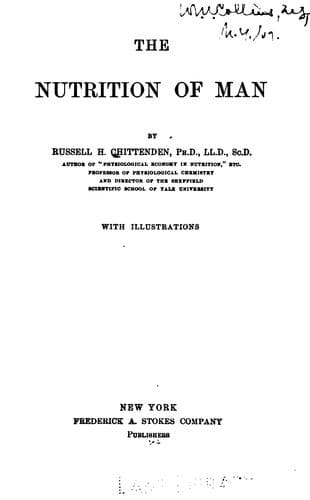
The nutrition of manChittenden, R. H. (Russell Henry)
Science
The nutrition of man
Chittenden, R. H. (Russell Henry)
Nutrition
Especially noticeable here is the low intake of fat and carbohydrate,
with the corresponding low fuel value, and also the relatively high
consumption of proteid, averaging 2.0 grams daily per kilogram of
body-weight. Dr. Fenger concludes that for a man of this age and
weight, with the relative inactivity characteristic of old age, a heat
value in the intake of 30 calories per kilogram of body-weight is quite
sufficient for the needs of the body. This may be quite true, but to
maintain nitrogen equilibrium under such conditions requires a larger
intake of proteid food than is desirable. It will be observed that in
the last period of four years a very decided change in the diet was
instituted; proteid was diminished somewhat, but the noticeable change
was the decided increase in fat, produced in large measure by the
substitution of whole milk, with its contained cream, for skim milk. In
the words of Dr. Fenger, this change was necessitated by the appearance
of gout in the subject. From superficial examination of the dietary of
the preceding eleven years there would seem no occasion for criticising
the subject for high living, and yet I believe we are quite within the
limits of reason in saying that the proteid exchange for a subject of
this body-weight was altogether too high. The heat requirements of the
body were being met in an unnecessarily large degree from the breaking
down of proteid material, with consequent formation of excessive
nitrogenous waste, among which uric acid was plainly conspicuous.
One comment to be made here is that meat and other rich
purin-containing foodstuffs are not the only source of gout and uric
acid. Excessive proteid katabolism, both exogenous and endogenous, is
a possible source of danger in this respect, and the above subject,
though living on an exceptionally simple diet, was consuming far more
proteid per kilogram of body-weight than was necessary or desirable.
Increase of fatty food naturally served to diminish the rate of proteid
katabolism, and this could have been advantageously accompanied by
a still greater reduction in the amount of proteid ingested, and a
larger addition of non-nitrogenous foodstuffs. In old age, there is
naturally a slowing down of the metabolic processes, and both nitrogen
equilibrium and body equilibrium can be satisfactorily maintained by a
relatively small intake of food and with gain to the body; but there
is every reason to believe that economy in proteid food can be more
advantageously adopted than economy in non-nitrogenous foodstuffs.
Public-domain text, read in full here on John Shaqi.
Reviews
Reviews
No reviews yet
Be the first to share your thoughts on this work.
Elsewhere in the archive
Join the Discussion
Join the discussion
Sign in to leave a comment or review.
Sign InorCreate an account