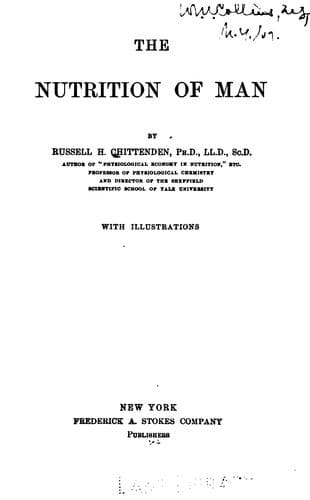
The nutrition of manChittenden, R. H. (Russell Henry)
Science
The nutrition of man
Chittenden, R. H. (Russell Henry)
Nutrition
Less obvious, though no less important, is the partial protection
that can be afforded to weakened or disabled kidneys by judgment and
discrimination in the matter of diet. In acute or chronic nephritis,
forms of so-called Bright’s disease, is there not danger of overtaxing
organs already weakened by placing upon them the daily duty of
excreting large amounts of solid nitrogenous waste, as well as of the
various inorganic salts which are so intimately associated with many of
the organic foodstuffs? The consumption of excessive and unnecessary
amounts of proteid food simply means the ultimate formation of just
so much more urea, uric acid, etc., which must be passed out through
the kidneys. In the words of Bunge, “There is no organ in our body so
mercilessly ill treated as the kidneys. The stomach reacts against
overloading. The kidneys are obliged to let everything pass through
them, and the harm done to them is not felt till it is too late to
avoid the evil consequences.” It would seem the part of wisdom,
therefore, to adjust the daily intake of proteid food to as low a
level as is consistent with the true needs of the body, in those cases
where the kidneys are at all enfeebled, or where it seems desirable to
exercise due precaution as a possible means of prevention.
Equal care is frequently called for in connection with the mineral
matters which enter so largely into many natural foodstuffs, or which
are introduced as condiments. As an illustration, we may note one or
two peculiarities in the distribution of sodium and potassium salts
in the tissues of the body. Potassium is an indispensable constituent
of every living cell, and the latter has the power of absorbing and
holding on to such amounts of this particular element as may be
necessary for the functional activity of the tissue of which it is a
part. Sodium, on the other hand, stands in a different relationship
to living structures. It is widely distributed, but in the higher
animals, as in man, sodium salts are most abundant in the fluids of
the body, notably in the plasma of the blood. Herbivorous animals have
a strong liking for sodium chloride or common salt, but this is not
true of carnivorous animals; indeed, the latter animals have a great
dislike for salty articles of food. Vegetable products are all rich in
potassium salts, whereas ordinary animal foods, such as meat, eggs,
milk, and blood, are relatively poor in this element.
Public-domain text, read in full here on John Shaqi.
Reviews
Reviews
No reviews yet
Be the first to share your thoughts on this work.
Elsewhere in the archive
Join the Discussion
Join the discussion
Sign in to leave a comment or review.
Sign InorCreate an account