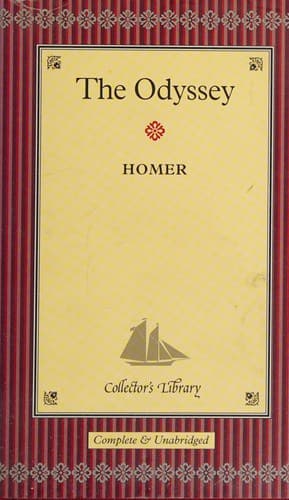
Epic poetry, Greek -- Translations into English; Homer -- Translations into English; Odysseus, King of Ithaca (Mythological character) -- Poetry
“To me it appears, that the architectonic functions ascribed by Wolf to
Peisistratus and his associates, in reference to the Homeric poems, are
nowise admissible. But much would undoubtedly be gained towards that
view of the question, if it could be shown, that, in order to
controvert it, we were driven to the necessity of admitting long
written poems, in the ninth century before the Christian aera. Few
things, in my opinion, can be more improbable; and Mr. Payne Knight,
opposed as he is to the Wolfian hypothesis, admits this no less than
Wolf himself. The traces of writing in Greece, even in the seventh
century before the Christian aera, are exceedingly trifling. We have no
remaining inscription earlier than the fortieth Olympiad, and the early
inscriptions are rude and unskilfully executed; nor can we even assure
ourselves whether Archilochus, Simonides of Amorgus, Kallinus Tyrtaeus,
Xanthus, and the other early elegiac and lyric poets, committed their
compositions to writing, or at what time the practice of doing so
became familiar. The first positive ground which authorizes us to
presume the existence of a manuscript of Homer, is in the famous
ordinance of Solon, with regard to the rhapsodies at the Panathenaea:
but for what length of time previously manuscripts had existed, we are
unable to say.
“Those who maintain the Homeric poems to have been written from the
beginning, rest their case, not upon positive proofs, nor yet upon the
existing habits of society with regard to poetry—for they admit
generally that the Iliad and Odyssey were not read, but recited and
heard,—but upon the supposed necessity that there must have been
manuscripts to ensure the preservation of the poems—the unassisted
memory of reciters being neither sufficient nor trustworthy. But here
we only escape a smaller difficulty by running into a greater; for the
existence of trained bards, gifted with extraordinary memory, is far
less astonishing than that of long manuscripts, in an age essentially
non-reading and non-writing, and when even suitable instruments and
materials for the process are not obvious. Moreover, there is a strong
positive reason for believing that the bard was under no necessity of
refreshing his memory by consulting a manuscript; for if such had been
the fact, blindness would have been a disqualification for the
profession, which we know that it was not, as well from the example of
Demodokus, in the Odyssey, as from that of the blind bard of Chios, in
the Hymn to the Delian Apollo, whom Thucydides, as well as the general
tenor of Grecian legend, identifies with Homer himself. The author of
that hymn, be he who he may, could never have described a blind man as
attaining the utmost perfection in his art, if he had been conscious
that the memory of the bard was only maintained by constant reference
to the manuscript in his chest.”
Public-domain text, read in full here on John Shaqi.
Reviews
Reviews
No reviews yet
Be the first to share your thoughts on this work.
Join the Discussion
Join the discussion
Sign in to leave a comment or review.
Sign InorCreate an account