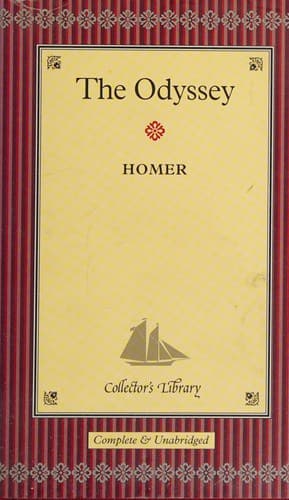
Epic poetry, Greek -- Translations into English; Homer -- Translations into English; Odysseus, King of Ithaca (Mythological character) -- Poetry
“If, however, not even such faint and indistinct traces of Athenian
compilation are discoverable in the language of the poems, the total
absence of Athenian national feeling is perhaps no less worthy of
observation. In later, and it may fairly be suspected in earlier times,
the Athenians were more than ordinarily jealous of the fame of their
ancestors. But, amid all the traditions of the glories of early Greece
embodied in the Iliad, the Athenians play a most subordinate and
insignificant part. Even the few passages which relate to their
ancestors, Mr. Knight suspects to be interpolations. It is possible,
indeed, that in its leading outline, the Iliad may be true to historic
fact; that in the great maritime expedition of western Greece against
the rival and half-kindred empire of the Laomedontiadae, the chieftain
of Thessaly, from his valour and the number of his forces, may have
been the most important ally of the Peloponnesian sovereign: the
pre-eminent value of the ancient poetry on the Trojan war may thus have
forced the national feeling of the Athenians to yield to their taste.
The songs which spoke of their own great ancestor were, no doubt, of
far inferior sublimity and popularity, or, at first sight, a Theseid
would have been much more likely to have emanated from an Athenian
synod of compilers of ancient song, than an Achilleid or an Odysseid.
Could France have given birth to a Tasso, Tancred would have been the
hero of the Jerusalem. If, however, the Homeric ballads, as they are
sometimes called, which related the wrath of Achilles, with all its
direful consequences, were so far superior to the rest of the poetic
cycle, as to admit no rivalry,—it is still surprising, that throughout
the whole poem the _callida junctura_ should never betray the
workmanship of an Athenian hand; and that the national spirit of a
race, who have at a later period not inaptly been compared to our
self-admiring neighbours, the French, should submit with lofty
self-denial to the almost total exclusion of their own ancestors—or, at
least, to the questionable dignity of only having produced a leader
tolerably skilled in the military tactics of his age.”
Public-domain text, read in full here on John Shaqi.
Reviews
Reviews
No reviews yet
Be the first to share your thoughts on this work.
Join the Discussion
Join the discussion
Sign in to leave a comment or review.
Sign InorCreate an account