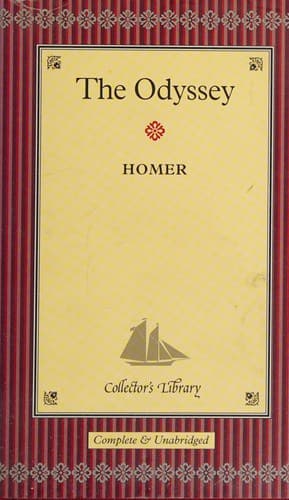
Epic poetry, Greek -- Translations into English; Homer -- Translations into English; Odysseus, King of Ithaca (Mythological character) -- Poetry
“While employed on the wild legend of Odysseus, he met with a ballad,
recording the quarrel of Achilles and Agamemnon. His noble mind seized
the hint that there presented itself, and the Achilleis grew under his
hand. Unity of design, however, caused him to publish the poem under
the same pseudonyme as his former work; and the disjointed lays of the
ancient bards were joined together, like those relating to the Cid,
into a chronicle history, named the Iliad. Melesigenes knew that the
poem was destined to be a lasting one, and so it has proved; but,
first, the poems were destined to undergo many vicissitudes and
corruptions, by the people who took to singing them in the streets,
assemblies, and agoras. However, Solon first, and then Peisistratus,
and afterwards Aristoteles and others, revised the poems, and restored
the works of Melesigenes Homeros to their original integrity in a great
measure.”
Having thus given some general notion of the strange theories which
have developed themselves respecting this most interesting subject, I
must still express my conviction as to the unity of the authorship of
the Homeric poems. To deny that many corruptions and interpolations
disfigure them, and that the intrusive hand of the poetasters may here
and there have inflicted a wound more serious than the negligence of
the copyist, would be an absurd and captious assumption; but it is to a
higher criticism that we must appeal, if we would either understand or
enjoy these poems. In maintaining the authenticity and personality of
their one author, be he Homer or Melesigenes, _quocunque nomine vocari
eum jus fasque sit_, I feel conscious that, while the whole weight of
historical evidence is against the hypothesis which would assign these
great works to a plurality of authors, the most powerful internal
evidence, and that which springs from the deepest and most immediate
impulse of the soul, also speaks eloquently to the contrary.
The minutiae of verbal criticism I am far from seeking to despise.
Indeed, considering the character of some of my own books, such an
attempt would be gross inconsistency. But, while I appreciate its
importance in a philological view, I am inclined to set little store on
its aesthetic value, especially in poetry. Three parts of the
emendations made upon poets are mere alterations, some of which, had
they been suggested to the author by his Maecenas or Africanus, he
would probably have adopted. Moreover, those who are most exact in
laying down rules of verbal criticism and interpretation, are often
least competent to carry out their own precepts. Grammarians are not
poets by profession, but may be so _per accidens_. I do not at this
moment remember two emendations on Homer, calculated to substantially
improve the poetry of a passage, although a mass of remarks, from
Herodotus down to Loewe, have given us the history of a thousand minute
points, without which our Greek knowledge would be gloomy and jejune.
Public-domain text, read in full here on John Shaqi.
Reviews
Reviews
No reviews yet
Be the first to share your thoughts on this work.
Join the Discussion
Join the discussion
Sign in to leave a comment or review.
Sign InorCreate an account