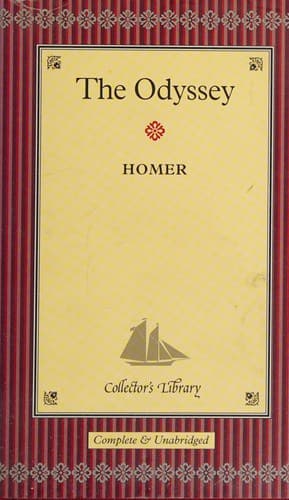
Epic poetry, Greek -- Translations into English; Homer -- Translations into English; Odysseus, King of Ithaca (Mythological character) -- Poetry
But it is not on words only that grammarians, mere grammarians, will
exercise their elaborate and often tiresome ingenuity. Binding down an
heroic or dramatic poet to the block upon which they have previously
dissected his words and sentences, they proceed to use the axe and the
pruning knife by wholesale; and, inconsistent in everything but their
wish to make out a case of unlawful affiliation, they cut out book
after book, passage after passage, till the author is reduced to a
collection of fragments, or till those who fancied they possessed the
works of some great man, find that they have been put off with a vile
counterfeit got up at second hand. If we compare the theories of
Knight, Wolf, Lachmann; and others, we shall feel better satisfied of
the utter uncertainty of criticism than of the apocryphal position of
Homer. One rejects what another considers the turning-point of his
theory. One cuts a supposed knot by expunging what another would
explain by omitting something else.
Nor is this morbid species of sagacity by any means to be looked upon
as a literary novelty. Justus Lipsius, a scholar of no ordinary skill,
seems to revel in the imaginary discovery, that the tragedies
attributed to Seneca are by _four_ different authors. Now, I will
venture to assert, that these tragedies are so uniform, not only in
their borrowed phraseology—a phraseology with which writers like
Boethius and Saxo Grammaticus were more charmed than ourselves—in their
freedom from real poetry, and last, but not least, in an ultra-refined
and consistent abandonment of good taste, that few writers of the
present day would question the capabilities of the same gentleman, be
he Seneca or not, to produce not only these, but a great many more
equally bad. With equal sagacity, Father Hardouin astonished the world
with the startling announcement that the AEneid of Virgil, and the
satires of Horace, were literary deceptions. Now, without wishing to
say one word of disrespect against the industry and learning—nay, the
refined acuteness—which scholars like Wolf have bestowed upon this
subject, I must express my fears, that many of our modern Homeric
theories will become matter for the surprise and entertainment, rather
than the instruction, of posterity. Nor can I help thinking that the
literary history of more recent times will account for many points of
difficulty in the transmission of the Iliad and Odyssey to a period so
remote from that of their first creation.
Public-domain text, read in full here on John Shaqi.
Reviews
Reviews
No reviews yet
Be the first to share your thoughts on this work.
Join the Discussion
Join the discussion
Sign in to leave a comment or review.
Sign InorCreate an account