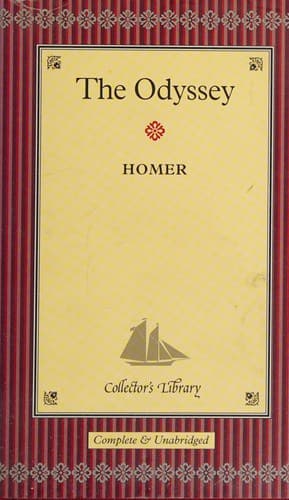
Epic poetry, Greek -- Translations into English; Homer -- Translations into English; Odysseus, King of Ithaca (Mythological character) -- Poetry
Pope was not a Grecian. His whole education had been irregular, and his
earliest acquaintance with the poet was through the version of Ogilby.
It is not too much to say that his whole work bears the impress of a
disposition to be satisfied with the general sense, rather than to dive
deeply into the minute and delicate features of language. Hence his
whole work is to be looked upon rather as an elegant paraphrase than a
translation. There are, to be sure, certain conventional anecdotes,
which prove that Pope consulted various friends, whose classical
attainments were sounder than his own, during the undertaking; but it
is probable that these examinations were the result rather of the
contradictory versions already existing, than of a desire to make a
perfect transcript of the original. And in those days, what is called
literal translation was less cultivated than at present. If something
like the general sense could be decorated with the easy gracefulness of
a practised poet; if the charms of metrical cadence and a pleasing
fluency could be made consistent with a fair interpretation of the
poet’s meaning, his words were less jealously sought for, and those who
could read so good a poem as Pope’s Iliad had fair reason to be
satisfied.
It would be absurd, therefore, to test Pope’s translation by our own
advancing knowledge of the original text. We must be content to look at
it as a most delightful work in itself,—a work which is as much a part
of English literature as Homer himself is of Greek. We must not be torn
from our kindly associations with the old Iliad, that once was our most
cherished companion, or our most looked-for prize, merely because
Buttmann, Loewe, and Liddell have made us so much more accurate as to
ἀμφικύπελλον being an adjective, and not a substantive. Far be it from
us to defend the faults of Pope, especially when we think of Chapman’s
fine, bold, rough old English;—far be it from us to hold up his
translation as what a translation of Homer _might_ be. But we can still
dismiss Pope’s Iliad to the hands of our readers, with the
consciousness that they must have read a very great number of books
before they have read its fellow.
THEODORE ALOIS BUCKLEY.
_Christ Church._
THE ODYSSEY OF HOMER.
BOOK I.
ARGUMENT.
MINERVA’S DESCENT TO ITHACA.
Public-domain text, read in full here on John Shaqi.
Reviews
Reviews
No reviews yet
Be the first to share your thoughts on this work.
Join the Discussion
Join the discussion
Sign in to leave a comment or review.
Sign InorCreate an account